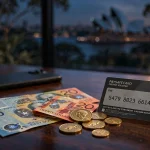
The advertised spin count does not establish eligibility, cash value, withdrawal rights, or whether the promotion is available to Australian residents.

A no-deposit bonus is a promotion described as giving a player casino funds or free spins without requiring an initial deposit. The phrase describes the claimed entry condition: money does not have to be paid into an account first. It does not, by itself, establish that the promotion is available to you, that the funds are cash, or that any resulting balance can be withdrawn.
That definition needs careful attribution. A specialist review has used “no-deposit bonus” for an offer providing funds or spins without an initial deposit. It should be read as a description of a type of promotion, not as proof that such offers are a standard feature of online casinos or are lawful for Australian residents. A headline promising 200 free spins, for instance, describes a quantity in an advertisement; those words alone do not establish the offer’s legal status or what the spins represent.
The distinction matters because “no deposit” can sound like an ordinary, low-risk way to try an online pokies service. The absence of an initial payment does not make the service legal, locally regulated, or protected by Australian consumer safeguards. Nor does it mean that the stated benefit is equivalent to withdrawable money. The label says only that an initial deposit is not required for the advertised bonus.
A “200 free spins no deposit” headline does not by itself tell you whether an offer is available to you or what conditions apply. Use this list as a starting point, then check the current promotion terms and eligibility before signing up.
Golden Pokies
The listed concrete detail for Golden Pokies is its Curaçao licence. Check the current offer terms to see whether a no-deposit promotion is available to you.
Lucky Dreams
Lucky Dreams is listed with a Curaçao licence and a minimum deposit of A$20 via POLi. Check the promotion terms to confirm whether the offer requires a deposit.
Roby Casino
Roby Casino is listed as licensed by Curaçao eGaming under Roby Games Ltd. Review the current promotion terms to establish whether the advertised offer is available to you.
Uptown Pokies
Uptown Pokies is listed as operating since 2017 under a Curaçao licence, with a minimum deposit of A$20. Check the specific offer conditions to find out whether a deposit is needed.
LevelUp Casino
LevelUp Casino is listed under Curaçao eGaming licence OGL/2023/174/0082, held by Dama N.V., and has a minimum deposit of A$15. Check the promotion terms before assuming the offer is deposit-free.
GoldenCrown
GoldenCrown is listed with a Curaçao Gaming Control Board licence, OGL/2023/176/0095, held by Hollycorn N.V. Check the current terms to confirm the offer's availability and conditions.
SkyCrown
SkyCrown is listed with a Tobique Gaming Commission licence and a minimum deposit of A$30. Its stated payout speeds are around 10–15 minutes for crypto and 1–5 days for fiat; check the offer terms to see whether a deposit is required.
Bizzo Casino
Bizzo Casino is listed under a Curaçao Gaming Control Board licence held by TechSolutions Group N.V. Check the current terms to determine whether the advertised promotion is available to you.
JustCasino
JustCasino is listed with a Curaçao Gaming Control Board licence. Review the current promotion terms to confirm availability and any conditions.
Thor Casino
Thor Casino is listed under a Curaçao licence held by Antillephone N.V. (Versus Odds B.V.) and has a minimum deposit of EUR 20. Check whether the specific promotion requires a deposit and whether its terms suit you.
In Australia, the legal issue is directed at the provider. The Interactive Gambling Act 2001 makes it illegal for Australian companies to offer online casino games to residents. The prohibited services include real-money online casino games such as slots and table games. This is not a system in which an Australian casino operator can simply obtain a local online-casino licence and offer these games to residents under that licence.
The law’s treatment of providers should not be confused with the position of individual players. Playing at an offshore casino is not a criminal offence for individuals in most Australian states. That does not make an offshore service locally approved, or give a player the protections that would come with a domestic consumer framework for online casino gambling. If a disagreement arises over an advertised bonus, account balance or payout, the player may not have access to local consumer protections against that offshore operator.
This difference is central to interpreting a no-deposit claim in Australia. A promotion may be described on a website as available to Australian users, but the wording of the promotion does not change the legal status of the underlying service. Likewise, a claim that no payment is needed does not establish that a provider is authorised to offer online casino games to people in Australia. The promotional label and the legal status are separate questions.
The phrase can tell you that a promotion is presented as not requiring an initial deposit. It cannot, on its own, tell you whether the offer is genuine, whether it is intended for Australian residents, or what conditions apply to the benefit. A free-spin count is not the same thing as a cash amount, and neither wording alone demonstrates that winnings can be withdrawn. Those details depend on the offer’s full conditions.
It is also important not to treat “free” as meaning consequence-free. A bonus can be conditional even when no initial deposit is requested. Its headline may attract attention, while the terms determine what the promotion actually provides. The basic definition therefore gives you only a starting point: it identifies the advertised payment condition, not the practical value of the offer.
For someone in Australia, the broader context comes first. Online casino services offered to people in the country are prohibited under the Interactive Gambling Act 2001, and offshore providers do not supply the same local consumer protection as a domestic service. Understanding the words “no deposit” helps you interpret what an advertisement claims, but it should not be mistaken for evidence that an online pokies promotion is lawful, locally protected or a reliable source of money.
Legal Warning
The Interactive Gambling Act 2001 makes it illegal for Australian companies to offer online casino games to residents. Offshore services are not locally approved and do not provide Australian consumer protections.
Registration and crediting are separate events. Completing an account form does not, by itself, show that a promotion has been attached to the account. A specialist review describes several possible routes for a no-deposit bonus: it may be added automatically at sign-up, activated with a bonus code, or held back until the account has passed a verification check. Which route applies depends on the promotion’s own claim process.
With automatic credit, the operator’s system links the bonus to a newly registered account without asking you to enter a code. The spins may appear as soon as registration is complete, or the account may need to pass another step first. If nothing appears, do not assume the offer has been activated simply because you finished the form. Check the account’s bonus or promotion area and the offer’s stated activation conditions before taking further action.
A code-based claim has an extra point where the process can fail. The code may need to be entered in a designated field during registration or later in the cashier. A specialist review notes that entering the correct code at the required stage can be essential: if you skip the field, mistype the code, or try to apply it in the wrong place, the bonus may not attach. Re-entering a code later is not necessarily possible, so identify where it belongs before completing the relevant step.
This distinction matters when a promotion is described in broad terms such as “free spins on sign-up.” That wording does not tell you whether the spins arrive automatically or whether you must select the offer or enter a code. A headline referring to 200 free spins, for instance, identifies a quantity, not the activation method. Treat the description of the claim process as a separate part of the offer, rather than assuming the account will receive the spins without further action.
Verification can also affect the sequence. A specialist review reports that some casinos ask for account details or identity checks before crediting spins. In that case, registration creates the account but does not complete the promotion claim; the operator first needs to confirm the information it requests. The offer should state what must be provided and when. Do not send documents through an unverified message or link: use only the account process described by the service, and consider whether providing personal information is appropriate.
To work out what has happened, follow the steps in order. First, note whether the promotion says it is automatic, code-based, or conditional on verification. Next, complete only the registration or confirmation steps specified for that route. Then check the account’s promotion area for an activation status or a record of the bonus. If the spins are not shown, compare the account state with the stated requirements before contacting support. This helps distinguish a delay caused by an unfinished check from a missed code or an offer that was never attached.
Keep a record of the promotion wording and any code you use. That record can help explain a discrepancy if the account display does not match what you expected. Do not assume that support can restore a missed claim: the result may depend on whether the code was entered at the required point and whether the account met the offer’s conditions.
Claiming Free Spins
Identify the route
Determine if the promotion is automatic, requires a bonus code, or is conditional on verification.
Complete requirements
Perform only the registration or confirmation steps specified for that particular route.
Verify activation
Check the account’s promotion area for an activation status or a record of the bonus.
Compare and resolve
If spins are missing, compare your account state with the stated requirements before contacting support.
For Australian readers, this is a description of how such claims are structured, not an invitation to use an online casino. The Interactive Gambling Act 2001 prohibits operators from providing real-money online casino games to people in Australia. The registration mechanics do not change that legal position.
A headline such as “200 free spins” describes the number of spins, not the amount you can withdraw. The offer terms determine what happens to any winnings: they may have to meet a playthrough requirement, and a cashout cap may limit the amount payable. Read those conditions together before deciding whether the offer has practical value.
A playthrough multiplier sets the amount of qualifying bets required relative to a stated base. That base matters. The terms may apply the multiplier to the bonus amount, to winnings from free spins, or to another defined amount. These are not interchangeable calculations. Check the wording that identifies the base, then the multiplier and any rules about which bets count. If the base is unclear, the total playthrough cannot be reliably calculated from the headline alone.
For context, a specialist review reports no-deposit bonus requirements in a range of 25x to 70x the bonus amount. The same kind of review places requirements on free-spin winnings between 40x and 60x. These are reported ranges, not a rule that applies to every offer. The specific terms control. A 200-spin offer may therefore have a different playthrough condition from another offer with the same number of spins, and the spin count alone does not reveal how demanding that condition is.
Also check whether the requirement applies to the bonus itself or to winnings generated from it. If the terms define a winnings-based requirement, the relevant base may not be the face value of the spins. Do not assume the calculation from the promotional headline: look for the clause that states the amount to be wagered and what counts towards completing it. A high multiplier can make a seemingly substantial offer difficult to convert into a payable balance, while the number of spins says nothing about the multiplier.
The other key limit is the cashout cap. This sets a ceiling on the amount that can be paid from bonus-related winnings, even if the balance exceeds that ceiling. A specialist review describes caps in a $10 to $100 range for some no-deposit bonuses, while another reported cap reaches A$1,000. Those figures show that limits can vary; they do not predict the cap on a particular promotion. Find the exact cap in the offer conditions and check which winnings it covers.
The cap and playthrough answer different questions. Playthrough concerns the qualifying betting needed to satisfy a condition. A cap concerns the maximum amount payable under that offer. Meeting a playthrough requirement does not, by itself, mean the full displayed balance can be withdrawn if a lower cap applies. Conversely, knowing the cap does not tell you how much betting is required first. Assess both terms rather than treating either one as a complete measure of value.
Before accepting a no-deposit promotion, locate the clauses that specify the playthrough base, the multiplier, the treatment of free-spin winnings, and the maximum cashout. Read the exact offer rather than relying on a general description or on the advertised quantity. If any condition is not stated clearly, the headline number cannot fill in the gap. A large spin count may sound significant, but the terms—not the count—set the limits on what the winnings can become.
Free spins are not necessarily usable across every game in a casino. An offer may attach them to one specified title or to a small group of games. The game restriction determines where the spins can be played; opening another title does not transfer the bonus to it.
Some offers identify a game before you claim the spins. In that case, the bonus is locked to that pre-selected title. Others may name several eligible games, but the permitted choices still come from the offer’s conditions. A headline that advertises a large number of spins does not, by itself, mean you can use them on any game.
Check the eligible-title wording before treating the spins as a general balance. If the offer names one game, look for that exact title in the game area. If it gives a short list, confirm that the title you intend to open appears there. A similar name or another game from the same provider may not qualify: the restriction is set by the specific titles named in the offer.
A game restriction can come with a minimum stake. A specialist review has described offers where the spins were restricted to a pre-selected game and required a minimum bet of 10 or 20 cents. Those figures should be read as conditions reported for particular offers, not as a rule that applies to every promotion.
The minimum matters because it can determine whether the free spins can be used at the stake shown in the game. If the offer requires a higher stake than the game’s current setting, the spin may not be available until you select an eligible value. Do not assume that changing the stake will be allowed: the promotion’s terms and the game’s settings determine which options are accepted.
Before starting, check three things together: the eligible game or games, whether the offer fixes one title in advance, and the minimum stake. If any of these details is unclear, the game itself may not make the restriction obvious. Rely on the offer conditions rather than assuming that a spin will work simply because the title is visible in the casino lobby.
This distinction is useful when comparing an offer described as free spins with one described as spins for a particular game. The first wording can sound broad, but the actual eligible titles may still be limited. The second signals a narrower use, although you should still confirm the named title and stake condition. In either case, the spin count tells you how many spins are offered, not where they can be used.
If a promotion lists several eligible titles, treat each listed title as a separate permitted option, not as evidence that all games qualify. If it names only one, do not expect the spins to follow you when you switch games. The restriction is part of how the offer is configured, so checking it first helps you predict what will happen when you open a game and try to use a spin.
An expiry condition can be easy to overlook when an offer is viewed on a phone. Small screens may show the headline and spin count prominently while placing the time limit in expandable terms, a separate information panel or text below the main button. Before relying on any displayed offer, inspect the full conditions rather than treating the visible summary as complete.
A specialist review reports that some no-deposit offers make unused free spins expire after 24 hours. That is a condition attached to some offers, not a universal deadline. The wording matters: check whether the clock starts at registration, when the spins are credited, or at another stated point. If the start point is unclear, the expiry time cannot be calculated reliably from the headline alone.
On a mobile screen, open the offer’s terms and look specifically for words such as “expire”, “valid until” and “unused spins”. Read the surrounding sentence, since a time limit may apply only to the spins, while another condition may govern a different part of the promotion. If the terms open in a separate panel or page, make sure you have not mistaken a short summary for the complete rules.
Check whether the expiry is expressed as a duration or a fixed date and time. A duration requires a clear start event; a fixed deadline requires you to know the applicable time zone. Do not infer either detail from the phone’s clock or from when you first noticed the offer. If the terms do not explain how the deadline is measured, regard that as unresolved rather than guessing.
A page may also refresh, collapse a panel or move you away from the terms when you switch apps. If you are reviewing the information on a phone, keep the relevant wording visible or note the deadline and its stated start point before leaving the page. Returning later to a shortened promotional banner may not show the same detail. If the offer’s terms cannot be read clearly on the small screen, use a larger display or contact the service for clarification rather than relying on the headline.
The advertised number of spins does not tell you how long they remain available. A large count can still be subject to a short expiry, and a countdown or promotional banner is not a substitute for the written condition. Treat the deadline as part of the offer itself: it determines whether unused spins remain available, not whether they are valuable or suitable.
For people in Australia, there is an additional context before considering any real-money online casino promotion. The Interactive Gambling Act 2001 prohibits operators from providing real-money online casino games to people located in Australia. Checking a mobile screen does not change that legal position. If you encounter a promotion, do not interpret its availability on a device as confirmation that the service is lawful for Australian residents.
Attention: Small mobile screens may hide critical expiry conditions in expandable terms or separate panels. Always inspect the full conditions rather than relying on the visible summary.
A balance displayed after free spins does not, by itself, mean that you can withdraw the same amount. Bonus winnings can remain conditional: the casino may require you to complete a playthrough before treating them as eligible for withdrawal. Until that condition is met, the balance is a record of winnings subject to the offer rules, not cash you can necessarily transfer out.
This distinction matters when a promotion is described as offering free spins for real-money play. The headline describes the spins, not the status of any winnings they produce. Even if a balance increases, the relevant question is whether the applicable bonus conditions have been completed and whether the casino will process a withdrawal. The displayed figure alone cannot answer either question.
A specialist review reports that casinos generally require identity verification before processing withdrawals, including withdrawals of winnings from a no-deposit bonus. Verification is a separate check from playthrough: completing one does not automatically satisfy the other. If identity documents have not been approved, a withdrawal request may be delayed even when the playthrough condition has been met. A review of the particular terms should make clear what verification is required and when it must be completed.
Some casinos also require a deposit before allowing no-deposit bonus winnings to be withdrawn, according to a specialist review. That condition changes the practical meaning of “no deposit”: it may describe how the bonus is first received, without promising that a withdrawal can be made without later depositing. Treat any deposit requirement as a real-money cost, not as a formality. If the condition is unclear, do not assume that a displayed balance can be claimed without paying in.
Playthrough can create another cost. A specialist review notes that trying to complete wagering requirements can lead players to spend money they had not planned to spend. This can happen when you continue playing to meet a condition, particularly if the bonus balance is insufficient or progress is slower than expected. The fact that a promotion begins without a deposit does not remove the risk of later spending.
There is also an important Australian legal context. The Interactive Gambling Act 2001 prohibits operators from providing real-money online casino games to people located in Australia. Offshore casino access is actively blocked and enforced, and Australian players do not have local consumer protection for such services. So the withdrawal process described in an offshore casino’s terms should not be treated as a reliable or locally protected way to obtain money. A balance shown on screen is not the same as an assured payment, and meeting a promotion condition cannot change the legal status of the service.
Free spins and a free chip are different bonus formats, so the number attached to one cannot be compared directly with the amount attached to the other. A free spin is a set number of plays tied to a particular game or games. A free chip is a stated balance of bonus funds that can be placed as bets, subject to the offer’s game restrictions.
A set number of plays tied to a particular game or group of games.
A stated balance of bonus funds that can be placed as bets, subject to game restrictions.
That distinction matters when you see a claim for 200 free spins. The figure tells you how many plays are offered, not how much cash you will receive or whether any winnings can be withdrawn. A free chip, by contrast, gives you a monetary amount to use under its terms, but that amount is not automatically withdrawable. Either format can have conditions that affect whether winnings become cash.
A specialist review reports that free chips are frequently limited to certain high-variance slots and excluded from live dealer games and high-return table games such as blackjack. Treat that as a description of the offers covered by that review, not a rule that applies to every promotion. Check the specific terms to see which games count and whether a bet contributes to the required playthrough.
The same distinction applies to the playthrough calculation. A specialist review reports requirements of 30 or 40 times the free-chip amount for some no-deposit offers. For a $50 free chip with a 30-times requirement, the calculation is $50 × 30, or $1,500 in total bets. That is the amount wagered across qualifying bets, not a target balance or a promise of a $1,500 return. The balance can change as bets are settled, and completing the required turnover does not guarantee a profit.
A specialist review also notes that a no-deposit bonus may have a maximum withdrawal of $50. If a cap applies, winnings above it may not be payable, even if the playthrough condition has been met. The cap and the calculation are separate terms: one sets a limit on what can be withdrawn, while the other determines how much qualifying betting is required.
When comparing a large free-spins count with a free chip, compare the actual conditions rather than the headline figures. For spins, identify what the count represents and how winnings are treated. For a chip, check the eligible games, the playthrough calculation and any withdrawal cap. Neither format, by itself, establishes that you will receive cash.
A promo code is an instruction used to associate an account with a promotion. It can be part of a claim process, but the code alone does not explain what the promotion contains. A code referring to 200 free spins, for instance, does not by itself confirm that the spins are free of a deposit condition, identify the games they apply to, or state what happens to any winnings.
The timing of entry can matter. A specialist review reports that entering an incorrect code, or entering it at the wrong stage, may mean the benefit is not applied. That makes the promotion’s own instructions more informative than the code’s wording: the instructions should say where the code belongs and what conditions attach to the offer. A code is not evidence that an account has received a promotion.
A promo code is simply an instruction to associate an account with a promotion; it does not independently confirm the offer's value, legality, or specific conditions.
Nor does a large headline value establish what can be withdrawn. A specialist review describes a $200 no-deposit bonus with playthrough requirements of 60x or 80x. Those figures illustrate why the code or advertised amount cannot substitute for the terms: the playthrough condition changes how much must be wagered before winnings may qualify for withdrawal. The precise conditions must be read as part of the promotion, not inferred from its name or code.
For Australian readers, there is a separate legal point. The Interactive Gambling Act 2001 prohibits operators from providing real-money online casino games to people in Australia. A casino promotion or promo code does not alter that position or make an offer lawful. Treat the code as a label within a promotion, not as proof of its value, its conditions, or its legal status.
A reference to Bitcoin in a casino promotion does not, by itself, explain how a no-deposit bonus works. It does not show that free spins are available, that a particular spin count applies, or that winnings can be withdrawn without further checks. Treat the payment method and the bonus conditions as separate parts of the offer.
Before relying on a Bitcoin-related claim, read the terms attached to the promotion. Check what must happen before a withdrawal is approved, rather than assuming that using cryptocurrency changes the rules. The important details are the conditions on the bonus and the account, not the currency named in a headline.
Identity checks can still apply when winnings came from a no-deposit bonus. A specialist review describes casinos as requiring identity verification before processing withdrawals, including withdrawals connected to bonus winnings. That means a balance displayed in an account should not be treated as proof that the money is ready to leave it. The casino may need to confirm who holds the account before handling a payout.
There can also be a deposit condition. A specialist review notes that some casinos require a minimum deposit before allowing a player to withdraw no-deposit bonus winnings. This is a separate condition from any payment method mentioned in promotional wording. If a deposit is required, check that term before you accept the bonus; do not assume that paying with Bitcoin removes it or satisfies it automatically.
A claim combining Bitcoin and a stated number of free spins therefore needs to be assessed on its written terms. Look for the bonus’s withdrawal conditions and any account checks. If the wording does not clearly state how those apply, do not infer a more favourable rule from the currency reference alone.
A headline promising 200 free spins tells you the quantity, not what the offer requires. The number alone does not show that the spins are available without a deposit, that winnings can be withdrawn, or that the promotion is lawful to provide in Australia.
The offer’s written conditions determine what the advertised count means. In one specific offer described by a specialist review, winnings from free spins had to be wagered 30 times within 5 days before they could become withdrawable. That is a condition attached to that offer, not a rule that applies to every promotion. It also means the stated spin count is only one part of the terms: the playthrough and deadline affect what must happen to any winnings.
Before treating a 200-spin claim as a no-deposit offer, check whether the terms explicitly say a deposit is not required. Then look for the playthrough applied to winnings, the time allowed to complete it, and any withdrawal conditions. If those details are not clear, the headline does not answer whether the offer suits your circumstances.
There is also a separate legal issue. Under Australia’s Interactive Gambling Act 2001, operators cannot provide real-money online casino games to people in Australia. A large spin count does not change that restriction or establish that a promotion is lawful. Avoid treating an advertised quantity as proof of either eligibility or a cashable outcome.
A promotion can advertise 200 spins without an initial deposit, but that headline alone does not prove the offer is genuine, available to Australian residents, or that winnings can be withdrawn. Online casino games offered to Australians are prohibited under the Interactive Gambling Act 2001, and offshore operators do not provide the same local consumer protections.
No deposit does not mean risk-free. Offshore casino services do not offer the same local consumer protections, and wagering conditions, withdrawal caps and verification requirements can apply to winnings.
A $200 no-deposit bonus may come with wagering requirements of 60x or 80x, and winnings may also be subject to a cashout cap. The no-deposit label does not mean the bonus is withdrawable cash or that the service is locally protected.
A no-deposit offer, by definition, does not require an initial deposit. However, some casinos may require a deposit before allowing you to withdraw winnings.
A no-deposit promotion may be credited automatically after sign-up, require a bonus code, or be credited after verification. Check the offer’s activation instructions, since the advertised spin count does not indicate how to claim it.
Some require a code, while others are credited automatically or after verification. If a code is required, enter it in the specified place and at the required stage of sign-up or in the cashier.