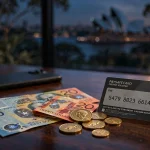
A practical guide to wallet transfers, casino processing, bonus terms, game access and the limits of Bitcoin for Australian players.

A Bitcoin payment passes through separate systems before it appears in a casino balance or reaches a personal wallet. The wallet creates and sends the transaction; the Bitcoin network records it; and the casino’s payment system detects and credits it. A withdrawal travels in the opposite direction, but it also has a casino-side processing stage. These stages matter because a transfer being visible on the blockchain does not necessarily mean the casino has credited the deposit or sent a withdrawal.
To make a deposit, you use the casino’s payment page to obtain its designated Bitcoin address and enter that address in your wallet as the destination. You specify the amount, then approve the transaction in the wallet. The wallet sends the transaction to the Bitcoin network, where it can be seen before it has been added to a block. At that point, it has been broadcast, but it is not yet confirmed.
The transaction is identified on the blockchain by a transaction ID. That identifier lets you inspect its status independently of the casino account balance. A transaction appearing in a wallet or blockchain viewer means it has been detected; it does not, by itself, prove that the casino has finished crediting the deposit.
If you’re looking for a casino that accepts Bitcoin in Australia, use this list as a starting point and check each operator’s current BTC availability and terms before depositing. The details below highlight only the information provided for each operator.
Golden Pokies
You can note Golden Pokies’ stated Curaçao license. No deposit or payout details are provided here.
Lucky Dreams
You can note Lucky Dreams’ stated Curaçao license and minimum deposit of A$20 via POLi. No Bitcoin-specific details are provided here.
Roby Casino
You can note that Roby Casino is listed as licensed by Curaçao eGaming under Roby Games Ltd. No deposit or payout details are provided here.
Uptown Pokies
You can note Uptown Pokies’ stated Curaçao license, operation since 2017, and minimum deposit of A$20. No Bitcoin-specific details are provided here.
LevelUp Casino
You can note LevelUp Casino’s stated Curaçao eGaming license, OGL/2023/174/0082, under Dama N.V., and minimum deposit of A$15. No Bitcoin-specific details are provided here.
GoldenCrown
You can note GoldenCrown’s stated Curaçao Gaming Control Board license, OGL/2023/176/0095, under Hollycorn N.V. No deposit or payout details are provided here.
SkyCrown
You can note SkyCrown’s Tobique Gaming Commission license and A$30 minimum deposit. Its listed payout speeds are around 10–15 minutes for crypto and 1–5 days for fiat.
Bizzo Casino
You can note Bizzo Casino’s stated Curaçao Gaming Control Board license under TechSolutions Group N.V. No deposit or payout details are provided here.
JustCasino
You can note JustCasino’s stated Curaçao Gaming Control Board license. No deposit or payout details are provided here.
Thor Casino
You can note Thor Casino’s stated Curaçao license through Antillephone N.V. under Versus Odds B.V., and its minimum deposit of EUR 20. No Bitcoin-specific details are provided here.
Confirmation occurs when a transaction is included in a block. Later blocks build on that block, adding further confirmations. The wait for the first confirmation is affected by network congestion and the fee attached to the transaction. A specialist review gives a possible range of 10–60 minutes for one confirmation, but that is a reported estimate, not a fixed Bitcoin timetable. Network conditions and the fee can make the wait shorter or longer.
After the network confirmation stage, the casino must apply its own crediting rule. A specialist review reports that many casinos wait for 1–3 confirmations before adding funds to an account. Treat that as a description reported in a review, not as a universal requirement: the number required depends on the casino’s payment process. The deposit can therefore be confirmed on the blockchain while the account still shows no available balance.
Some casinos are reported by specialist reviews to allow play after detecting a deposit but before it is fully confirmed. That is a separate account policy, not a change to the blockchain status. If a site displays an early or pending credit, the network transaction may still be awaiting confirmation. The amount shown in the account and the transaction’s confirmation state describe different parts of the payment flow.
The practical sequence is therefore: wallet approval, network broadcast, confirmation, and casino crediting. A delay at any stage has a different cause. If the transaction has not appeared on the network, the issue is before confirmation. If it appears but has no confirmation, the network has not yet included it in a block. If it is confirmed but absent from the casino balance, the remaining step is the casino’s own payment handling.
A withdrawal begins inside the casino account. You request a Bitcoin payout and provide the wallet address where you want to receive it. The casino may first require identity documents before it will process a withdrawal. That check is separate from the blockchain: a transaction cannot be confirmed until the casino has approved and sent it.
Once the casino releases the payout, it broadcasts a Bitcoin transaction. Only then can the network confirmation process begin. Before that point, the withdrawal may be marked as pending in the account even though no transaction is yet visible on the blockchain. After broadcast, the transaction ID provides a way to follow its progress; confirmation then depends on the network, as it does for a deposit.
A specialist review reports that casino-side withdrawal processing can take 12–48 hours before a Bitcoin payout is sent. This is a reported range from that kind of source, not a dependable service standard for every casino or request. The important distinction is that this time is spent before the casino broadcasts the transaction. It should not be confused with the time the Bitcoin network takes to confirm a payout after broadcast.
A Bitcoin withdrawal involves two distinct timeframes: the casino's internal processing time (reported as 12–48 hours) and the subsequent network confirmation time.
The same type of review reports that a Bitcoin withdrawal can reach a personal wallet within an hour after casino processing. That timing describes the network leg after the casino has sent the payment; it does not include any time the casino takes to review or approve the request. Neither estimate guarantees when a particular withdrawal will arrive. The account’s status and the blockchain record help show which stage is still in progress.
In short, deposits and withdrawals each have two clocks: the casino’s internal handling time and the blockchain’s confirmation time. A deposit must be sent and confirmed before it is credited under the casino’s rules. A withdrawal must be reviewed and released before the network can deliver it. Keeping those stages distinct makes a pending balance or payout easier to interpret without treating every delay as a Bitcoin network problem.
A ranking can show which sites a publisher has chosen to feature, but it cannot establish whether an operator is authorised to serve people in Australia or whether its website is accessible here. Assess those questions separately. A site can accept Bitcoin and appear in a list without having any Australian regulatory status.
Start with the operator’s regulatory position. Crypto casinos do not hold Australian licences, so they operate outside Australia’s regulatory framework. Do not treat a Bitcoin payment option, an offshore licence claim or a prominent position in a comparison table as evidence of Australian approval. If an operator names a regulator or licence, check that the claim identifies the legal entity responsible for the service and the jurisdiction in which it says it is licensed. That information may help you understand the operator’s stated status, but it does not turn the service into an Australian-licensed casino.
Next, distinguish a site’s own claims from information about its availability in Australia. The Australian Communications and Media Authority (ACMA) works to restrict access to offshore gambling services that are not permitted to operate here. It has taken action against multiple operators, including banning them from the Australian market and blocking their websites. A site being reachable at one point does not, by itself, show that it is approved or that access will remain available.
Check the exact web address rather than relying on a search result, advertisement or old bookmark. Similar-looking domains can refer to different services, and a page that loads may not be the operator’s official site. If a site is unavailable, do not assume that a new address or a technical workaround is an acceptable route around the restriction. Avoid using a VPN to bypass geographic limits; doing so may breach the site’s terms and put an account or its balance at risk.
A useful assessment therefore separates three things: what the operator says about its licence, what Australian regulators permit, and whether the site can currently be accessed. These are not interchangeable. An offshore licence claim does not amount to domestic authorisation, while technical access does not establish regulatory approval. Likewise, a listing or a favourable review is not a regulator’s decision.
Treat “best” as a personal suitability question, not a regulatory category. A site may advertise a Bitcoin deposit option, games or a bonus, but those features do not answer whether the operator is authorised for Australian customers or whether its service is available to them. Compare the claims carefully, and give more weight to verifiable information about the responsible company and regulatory status than to promotional labels.
Avoid using a VPN to bypass geographic limits, as doing so may breach the site's terms and put your account or balance at risk.
If you are registered with BetStop or a state-based self-exclusion program, self-exclude directly with each offshore platform as well. A domestic exclusion registration should not be assumed to apply automatically to an offshore site. This is a separate check from whether the website loads or what payment methods it displays.
The practical result is a cautious reading of any casino list: use it to identify claims that need checking, not as proof that an operator is approved, safe or suitable for Australian residents. Do not infer Australian licensing from Bitcoin acceptance, an offshore credential, or a working webpage.
Bitcoin is a payment method, not a rule change. A casino may describe its cashier as accepting BTC, but that tells you how it handles deposits or withdrawals; it does not determine whether the games it offers may be provided to people in Australia. The distinction matters especially for live casino play, where a payment feature can be mistaken for evidence that the games themselves are available lawfully.
A live dealer game is still an online casino game. The dealer may appear on a video stream while you make decisions through the site, but adding a human presenter does not alter the game’s legal category. Nor does using Bitcoin turn an online service into something outside the rules that apply to casino games offered to Australian residents.
The Interactive Gambling Act 2001 prohibits operators from providing online casino-style games to people in Australia. That category includes games such as blackjack and roulette, whether they are presented with a live dealer or through another online format. The Act also does not create an Australian licence under which an operator can offer those online casino games to residents. A Bitcoin cashier cannot supply that missing permission.
This separates two questions that are often bundled together: can an account accept Bitcoin, and can the operator provide a particular game to someone in Australia? The first concerns payment handling. The second concerns the service being offered and the law governing it. A positive answer to the payment question does not answer the legal one.
The same distinction applies when a site uses phrases such as “live casino,” “live dealer” or “BTC casino.” Those labels describe features or branding, not an exemption. A page showing a dealer, a table interface or a Bitcoin symbol does not establish that the operator is entitled to make the game available to Australian residents. Payment technology does not change the nature of the underlying activity.
This is also why claims about a “best” live casino that accepts Bitcoin cannot be judged on the cashier alone. A list based on coin support may tell you which payment method a site advertises, but it cannot establish that its live games may lawfully be offered in Australia. Treating a fast or convenient deposit route as proof of legal availability confuses a technical capability with a legal status.
The practical point is not that Bitcoin makes live play more or less lawful. It does neither. It may be one way a service processes funds, while the legality of providing online casino games remains a separate issue. If a service offers real-money live blackjack or roulette to people in Australia, accepting BTC does not make that offer permissible under the Interactive Gambling Act.
Using Bitcoin as a payment method does not make the provision of online casino games permissible under the Interactive Gambling Act 2001.
Keep those categories separate when interpreting a site’s descriptions. Payment wording tells you about the payment option; live-game wording tells you what kind of entertainment is being offered. Neither should be read as a substitute for the other, and the presence of a Bitcoin option does not change the rules that apply to online casino games for Australian residents.
A Bitcoin casino deposit bonus is not simply extra BTC added to your balance. It is a promotion governed by conditions that can affect whether you may withdraw funds and how much you can cash out. Read the full terms before opting in or sending a deposit; a headline offer does not show how the conditions work together.
Start with the wagering requirement. Check what balance it applies to: the bonus, your deposit, or both. Then identify which bets count towards it and whether a time limit applies. Do not assume that placing bets equal to the stated requirement clears it: the terms may define qualifying play more narrowly. If the wording does not explain how progress is calculated, treat that as unresolved rather than guessing.
Next, check game restrictions. A promotion may exclude some games or assign different contribution rules to different categories. Look for the specific game types covered, any excluded titles, and whether switching between games changes progress. A promotion described as suitable for online Bitcoin slots does not, by itself, establish that every game qualifies or that the bonus can be withdrawn after play.
Read the maximum cashout condition separately. It may cap the amount you can withdraw from bonus-related play, even if your displayed balance is higher. Check whether the cap applies to winnings, the bonus balance, or another defined amount, and what happens to funds above it. If the terms do not make that clear, do not infer that the full account balance is withdrawable.
Payment rules matter too. Confirm whether deposits made in Bitcoin qualify, whether the bonus must be claimed before or after depositing, and whether using Bitcoin affects eligibility for withdrawals. Some promotion terms exclude particular payment methods or treat deposits and withdrawals differently. Verify that the relevant conditions apply to your payment choice rather than relying on a general bonus description.
Check identity-verification terms before accepting. Players must provide identity documents before withdrawals can be processed, so a bonus does not remove that requirement. Also review any account or location restrictions. If you are registered with BetStop or a state-based self-exclusion program, you must self-exclude directly at each offshore platform; do not treat a promotion or an existing registration as a substitute for that step.
Finally, consider the value in Bitcoin rather than only the displayed BTC amount. Bitcoin’s price can change between depositing, wagering and withdrawing, so the Australian-dollar value of a balance or promotion may move even when its BTC amount stays the same. Network fees may also affect what reaches your wallet. The terms should make clear how the casino records bonus balances and settles eligible withdrawals; do not assume that a displayed promotional amount is equivalent to withdrawable cash.
A sensible decision is to accept a promotion only when you can explain its qualifying play, game exclusions, cashout cap and Bitcoin-payment rules in your own words. If one of those points is unclear, declining the offer avoids attaching uncertain conditions to your deposit.
The legal distinction is between the person accessing a service and the business providing it. Under the Interactive Gambling Act 2001, the main restriction falls on operators: they cannot offer covered online casino services to people in Australia. The Act does not make the Australian player the target of that prohibition.
Australia does not issue a domestic licence for online casino games. A casino with a Bitcoin option therefore cannot hold an Australian online-casino licence. If it operates under a licence issued overseas, that licence applies within the framework of the issuing jurisdiction; it does not become an Australian licence or remove the operator’s obligations under Australian law.
For players, the position is different. The Act’s prohibition is directed at the provider, and it is not illegal for an Australian to play at an offshore-licensed online casino. This does not mean that the service is authorised to offer online casino games to people in Australia. Nor does paying with Bitcoin create a separate legal route: cryptocurrency changes the payment method, not who the law regulates or what the operator may provide.
This distinction matters when you encounter claims that a crypto casino is “licensed”. Ask what that statement means in context: a foreign licence is not domestic approval. Crypto casinos are not licensed in Australia and sit outside the country’s regulatory framework. That means an Australian licence does not provide a basis for treating a Bitcoin casino as locally authorised.
The practical result is not that every offshore site is legally available or protected from enforcement. Australian rules focus on the operator, while the player’s position is not the same as the operator’s. A foreign licence and a Bitcoin payment do not convert an offshore casino into an Australian-regulated service.
So, when you see “casino that accepts Bitcoin” or “casino with BTC” described as available to Australians, separate three questions: whether the operator has a licence somewhere, whether it is permitted to offer the service to people in Australia, and whether the player is personally prohibited from accessing it. Those questions do not have interchangeable answers. The presence of a licence abroad does not establish Australian authorisation, and Bitcoin does not change the legal classification of the service.
Before you fund an account, check the details that determine where your Bitcoin goes, whether you can withdraw it, and whether you can access the service from Australia. These are separate checks: a correct deposit does not establish that the site may lawfully offer online casino games to people in Australia.
Confirm the payment route. Read the casino’s deposit instructions inside your account and use the address it specifies for that transaction. Check that the selected currency is Bitcoin and that the network shown by the casino matches the network selected in your wallet. A valid address on the wrong network is not a safe substitute: crypto sent to an incompatible address or network may be permanently lost. Do not copy an address from an old transaction or rely on a saved address without checking it against the current instructions.
Check the withdrawal route before depositing. Find out whether the casino supports Bitcoin withdrawals, and whether it requires the same network you intend to use. A deposit method does not, by itself, prove that the same coin or network is available for payouts. Also check the withdrawal instructions and identity-verification requirements. Players must provide identity documents before withdrawals can be processed, so confirm how that process works before sending funds.
Keep access restrictions in view. Do not use a VPN to get around a location block or other geographic restriction. Bypassing a restriction can breach the platform’s terms and may lead to account closure or voided winnings. If you are registered with BetStop or a state-based self-exclusion program, you must also self-exclude directly with each offshore platform; registration with one program does not perform that step for you.
The Interactive Gambling Act 2001 prohibits operators from providing real-money online casino-style games to people in Australia. An offshore licence does not amount to an Australian online casino licence or make the service authorised under Australian law. The Act does not explicitly refer to Bitcoin, and Australian players are not generally made criminally liable simply for accessing an offshore service. The payment method does not change the operator’s obligations.
Bitcoin’s price can move between deposit and withdrawal, so the AUD value of the amount you receive may differ from the value you sent. Treat the casino balance as exposed to that price movement, not as a fixed Australian-dollar amount.
A specialist review describes some casinos allowing play after a deposit is detected on the blockchain, before it is fully confirmed. That is an operator-specific arrangement, not a signal that you should skip the address, network, withdrawal, or access checks. Wait until the casino’s own account status shows the deposit as available before relying on it.
Bitcoin changes how funds may be transferred; it does not change which online casino games may be offered to people in Australia. Paying with BTC does not create an exception to the Interactive Gambling Act 2001 or make a prohibited game permissible.
The Act does not specifically name Bitcoin or other cryptocurrencies. Its rules instead apply to the service being provided. It prohibits operators from providing online casino-style games to Australian residents, including pokies, poker, blackjack and roulette. The payment method does not alter the nature of those games: a game does not become lawful to offer because an account is funded with Bitcoin rather than another payment method.
This distinction matters when a site describes its products as Bitcoin casino games or presents them as games played with cryptocurrency. Bitcoin is a way to fund an account, not a separate category of game. If the service lets you wager real money on online pokies, poker, blackjack or roulette, using BTC does not change the legal position of that offering for people in Australia.
Nor does a cryptocurrency label make a game lawful merely because the operator is offshore. A site may accept Bitcoin and display games under different names or formats, but the relevant question is what it lets customers do. If it provides real-money online casino-style games to people in Australia, the payment method does not remove the prohibition on the operator.
Payment technology does not change the legal nature of the activity; online casino-style games remain prohibited for operators to provide to people in Australia regardless of the currency used.
This is separate from the mechanics of a Bitcoin payment. A successful transfer says only that funds moved; it does not establish that the operator may offer the game to Australian residents. Likewise, a game being accessible on a website does not mean it is permitted under Australian law.
If you are comparing a Bitcoin gambling site’s game menu, treat the payment option and the game offering as separate matters. Do not infer that a Bitcoin slot game, poker table or roulette wheel is available lawfully just because the site accepts BTC. The same applies when a platform groups games under a general “crypto games” label: the label does not change what the games are or the rules that apply to their provision.
Players registered with BetStop or a state-based self-exclusion program must also self-exclude directly with each offshore platform; registration does not automatically apply there. Before any withdrawal, the platform may require identity-verification documents. These checks do not make an otherwise prohibited game offering permissible.
A “Bitcoin casino” is an online gambling service that accepts Bitcoin as a way to fund an account or receive a payout. The label describes a payment method, not a special category of Australian gambling licence. A site may also accept other cryptocurrencies, but using BTC does not place its services within Australia’s regulatory framework.
For an Australian player, the practical distinction is between the currency used and the operator providing the service. Bitcoin is recorded and transferred through its own network; it does not change where the operator is licensed, whether the site can be accessed, or which rules apply to its gambling services. A page describing a site as an Australian Bitcoin casino should not be read as evidence that the site holds an Australian authorisation. Australia does not license online casino games domestically.
These services are generally operated offshore and are not licensed in Australia. The Australian Communications and Media Authority (ACMA) works to restrict access to offshore gambling sites that are not authorised to serve people in Australia. It can block sites, and it has done so for operators. Blocking is an access measure, not a sign that a site is locally regulated; nor should a site’s continued appearance online be taken as proof of approval.
ACMA’s responsibilities also extend across gambling categories such as sports betting, lotteries and bingo. Their regulatory treatment differs from online casino services, so the fact that the same authority oversees them does not mean every type of gambling service is treated alike. The Bitcoin label does not alter that distinction.
“BTC casino” and “crypto casino” are informal descriptions rather than legal statuses. They tell you something about the payment options a service claims to support, but not whether it is authorised for Australian customers or whether it will remain accessible. Do not use a VPN to get around a location restriction; bypassing one can breach a site’s terms and put an account or winnings at risk.
Before engaging with any offshore service, consider the practical consequences as well as the label. Bitcoin’s value can change between deposit and withdrawal, affecting the Australian-dollar value of funds. If you are registered with BetStop or a state-based self-exclusion program, you must also self-exclude directly with each offshore platform; registration does not automatically apply there. Any required identity checks remain relevant too: a casino may require verification documents before processing a withdrawal.
A Bitcoin deposit begins with the destination address shown in the casino cashier. Compare that address with the one displayed in your wallet before approving the transfer. A single incorrect character can send the funds somewhere you cannot recover them. Also check the required network: the network selected in your wallet must match the casino’s instructions. Sending Bitcoin over an unsupported network can result in permanent loss.
Bitcoin transfers cannot be reversed by a bank or payment provider. Once broadcast, a transaction generally cannot be cancelled or redirected. Treat the address and network check as a final authorisation step, not an administrative detail.
The fee is separate from the amount sent. Bitcoin network fees change with network demand and the fee setting on your transaction. A specialist review has reported fees reaching AUD 10–20 per transaction during peak periods; that is a time-specific report, not a fixed rate or a prediction of what your transfer will cost. Check the fee displayed by your wallet before confirming. If the fee is deducted from the amount you send, the casino may receive less than the deposit amount you intended.
A specialist review also describes offshore Bitcoin deposits as being credited after blockchain confirmations. Until the transaction is confirmed and the casino credits it, a completed wallet transfer may not appear as an available account balance. Keep the transaction details so you can identify the payment if you need to query a delay.
Bitcoin’s exchange value can move between the time you acquire it, deposit it and later use or withdraw it. The amount shown in Australian dollars may therefore change even if the BTC amount does not.
Before depositing, verify that the casino supports Bitcoin withdrawals; support for deposits alone does not establish that. Players must provide identity documents before withdrawals can be processed. If you are registered with BetStop or a state-based self-exclusion program, self-exclude separately at each offshore platform.
Bitcoin changes how funds are transferred; it does not change what a game is or whether it may be offered to people in Australia. A slot game funded with BTC remains an online casino-style game. Under the Interactive Gambling Act 2001, providing online slots to Australian residents is prohibited. Paying in cryptocurrency does not create an exception, and an overseas licence does not make the service lawful to offer here.
That distinction matters when you encounter claims about Bitcoin slots or a “licensed” Bitcoin casino. A licence from another jurisdiction describes the operator’s position there; it is not an Australian online-casino licence. Australia does not issue domestic licences for online casino games, and the law’s restriction concerns the operator providing the service to people in Australia. Bitcoin is a payment asset, not permission to access a game.
There is also a separate financial risk. Bitcoin’s market price can move between the time you acquire it, send it, receive it back and sell it. A win shown in BTC may therefore be worth a different amount in Australian dollars later. The game result and the value of the cryptocurrency are distinct: one determines how much BTC you hold, while the market price determines its fiat value when converted.
For tax, the ATO generally treats recreational gambling winnings as windfalls rather than taxable income. Cryptocurrency has a different tax treatment: the ATO regards it as an asset for capital gains tax purposes. If you later sell BTC for more than its relevant acquisition cost, the price increase may create a capital gain, even when the BTC came from a casino withdrawal. The gambling outcome and the later disposal of the asset should not be treated as the same event.
Keep records of BTC acquisition, deposits, withdrawals and later sales so the movement of the asset and any change in its value can be distinguished. This does not alter the legal status of online slot play in Australia.
Yes, you can request a Bitcoin payout to your wallet address. The casino may review the request before sending it; once sent, the transaction can be tracked on the blockchain.
Bitcoin payments go directly between your wallet and the casino, and transactions are recorded on the blockchain so you can verify their status. After a casino sends a withdrawal, the network transfer may reach your wallet within an hour, though casino processing takes place first.
Bitcoin, Litecoin and Ethereum are used at crypto casinos. Litecoin is widely accepted and has lower network fees than Bitcoin or Ethereum, while Bitcoin fees can rise during busy periods.