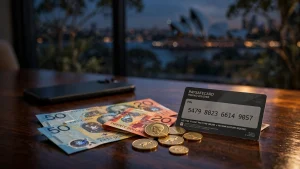
An EcoPayz reference alone does not confirm that a casino accepts deposits, serves Australians, or supports a particular withdrawal route.

A search for Australian pokies associated with EcoPayz expresses a specific kind of uncertainty: whether a payment service is accepted by a particular gambling operator. It does not, by itself, show that any operator accepts EcoPayz, that a payment would be available to someone in Australia, or that a service is lawful to provide there. The wording describes what the person wants to find out, not a confirmed arrangement.
That distinction matters because several separate things can be compressed into a short phrase. “Australian” might describe the person searching, the audience an operator claims to serve, or the location where a service is offered. “Pokies” identifies the type of gambling product the person has in mind. “EcoPayz” identifies the payment method they hope to use. None of those terms establishes a relationship between the payment method and a particular service.
A statement that a site accepts EcoPayz would need to be tied to that site and to a current, clearly defined payment function. A general reference to EcoPayz on a page, or a mention of the service alongside casino content, would not establish that it can be used for a gambling transaction. Nor would it establish that the payment option is available to every visitor. Search wording alone cannot resolve those distinctions.
If you’re looking for an Australian casino site that accepts ecoPayz, use this list as a starting point and confirm the payment methods available to you before signing up.
Golden Pokies
Golden Pokies is listed with a Curaçao licence.
Lucky Dreams
Lucky Dreams has a Curaçao licence and a minimum deposit of A$20 via POLi.
Roby Casino
Roby Casino is listed as licensed by Curaçao eGaming, with Roby Games Ltd named in the licensing details.
Uptown Pokies
Uptown Pokies has a Curaçao licence, has been operating since 2017, and has a minimum deposit of A$20.
LevelUp Casino
LevelUp Casino is licensed by Curaçao eGaming under OGL/2023/174/0082, with Dama N.V. named in the licence details. Its minimum deposit is A$15.
GoldenCrown
GoldenCrown is listed under a Curaçao Gaming Control Board licence, OGL/2023/176/0095, with Hollycorn N.V. named in the licence details.
SkyCrown
SkyCrown is licensed by the Tobique Gaming Commission and has a minimum deposit of A$30. Its listed payout times are around 10–15 minutes for crypto and 1–5 days for fiat.
Bizzo Casino
Bizzo Casino is listed as licensed by the Curaçao Gaming Control Board, with TechSolutions Group N.V. named in the licensing details.
JustCasino
JustCasino is listed with a Curaçao Gaming Control Board licence.
Thor Casino
Thor Casino is listed as licensed in Curaçao under Antillephone N.V., with Versus Odds B.V. named in the licence details. Its minimum deposit is EUR 20.
The same limit applies when someone looks for an Australian online casino accepting EcoPayz or for Australian pokies linked to that payment method. Such wording can express an intended combination, but it cannot prove that the combination exists. A result may repeat a claim, use broad promotional language, or refer to a different market. Without a reliable basis for the specific claim, the result should not be treated as confirmation.
The word “best” adds another implied claim. It suggests that eligible services have been identified and compared according to some relevant measure. But a payment-method label alone does not show that an operator is suitable, that the service is available to an Australian resident, or that any comparison is sound. A ranking cannot turn an unconfirmed acceptance claim into a verified one.
There is also a legal distinction behind the phrase “Australian casino.” Under the Interactive Gambling Act 2001, operators are prohibited from providing real-money online casino games to people physically located in Australia. The fact that a service is described as Australian-facing, or appears in material aimed at Australians, does not mean that it is legally permitted to offer those games in Australia. Australian consumer law does not protect people who use offshore casinos. These points are separate from whether a payment method is mentioned or accepted.
For that reason, a search result should be read as a claim to examine, not as evidence of availability. The key question is not simply whether EcoPayz appears on a page. It is what the claim actually covers, whom it applies to, and whether it is consistent with the legal position for people in Australia. If those points are unclear, the wording does not provide a dependable answer.
A mobile-oriented phrase does not change the standard. “Mobile casino” describes a way of accessing a service, not proof that EcoPayz is supported on a phone or that a gambling service may lawfully be offered to Australians. The device, the payment method and the gambling product are different parts of the claim. Treating them as one confirmed package would go beyond what the wording establishes.
So, searches combining EcoPayz, Australian pokies and online casinos reveal an interest in payment availability, but they cannot identify a confirmed provider or establish a lawful offer. They also cannot show that any particular payment arrangement is available to a person in Australia. Keep the distinction clear: a phrase can describe what someone is seeking, while leaving the underlying claims unproven.
A request to fund an account with EcoPayz contains several separate questions. Does a particular service make EcoPayz available for deposits? What amount would it accept? Would a charge apply? Those answers depend on the payment terms presented for that service and cannot be inferred from the payment method’s name alone.
Attention: A stated minimum deposit for one payment option does not establish the minimum for another, including EcoPayz.
For a small deposit, the key detail is not simply whether EcoPayz appears somewhere on a payment page. You would need to know the minimum amount the cashier accepts for that transaction, whether the minimum changes with the selected method, and whether any separate account-funding rule applies. A stated minimum for one option would not establish the minimum for another. Without terms that specifically cover EcoPayz deposits, there is no sound basis for saying that a particular low amount will be accepted.
The same distinction matters when looking for a casino that accepts EcoPayz deposits. A general mention of EcoPayz does not, by itself, establish that it can be used to add funds. It could refer to a different part of a payment process, or to information that does not apply to the account or location in question. To establish deposit availability, the relevant cashier would need to show EcoPayz as a selectable funding method under the applicable terms. A broad claim that a service “supports” a payment method is less precise than a deposit rule that explains when and how it can be used.
Fees need separate checking. The amount entered in a cashier is not necessarily the only figure relevant to a deposit: a charge could be described in the operator’s terms, by the payment provider, or by another party involved in processing. Those are different possible sources of cost, so a clear fee statement should identify what the charge applies to and who imposes it. No EcoPayz-specific deposit fee can be assumed in advance. Nor does the absence of a visible fee in a general description establish that every transaction is free.
When reviewing a deposit condition, look for its scope. Does it apply to all funding methods or only to EcoPayz? Is it tied to a particular account status, currency, or transaction route? Does the displayed amount refer to the sum you enter, or to the amount credited after any deductions? These details affect what a deposit term means. If the wording does not distinguish them, it does not answer the practical question completely.
The cashier is the relevant point for a transaction-specific choice, but its display should be read alongside the service’s written payment terms. A method appearing in a general help page is not proof that it is available to every customer. Conversely, a payment option shown in a cashier needs to be understood in the context of the conditions attached to it. If the method is absent, a deposit cannot be treated as available on the basis of an unrelated reference to EcoPayz. If it appears, the amount and any applicable charges still need to be clear before you proceed.
A careful comparison of deposit claims therefore needs more than a list of names. It needs current, specific terms that connect EcoPayz to account funding and state the accepted amount and any charges. Without those details, calling one option the best for deposits would turn an unanswered question into a recommendation. The same applies to a claim that a small deposit is possible: it requires an explicit EcoPayz deposit minimum, not an assumption drawn from another payment method or from a general account rule.
This distinction is useful whenever you encounter wording such as “deposit with EcoPayz.” Treat it as a claim to verify, not as a complete description of the transaction. Check whether it concerns adding funds, whether the relevant terms apply to your circumstances, and whether the cashier and written conditions agree. If the deposit amount or fee is unclear, the information available does not support a reliable estimate. A precise answer requires EcoPayz-specific deposit terms; general payment descriptions cannot supply one.
“Instant” can describe several different events in a payment, and those events are not interchangeable. A deposit may be authorised by a payment provider, recorded by an account, or made available for use at different points in a transaction. A withdrawal has its own stages: a request can be submitted, reviewed, approved, sent, and then received. A claim about one stage does not establish that the entire process is immediate.
That distinction matters when a payment method is named alongside a speed claim. “Instant EcoPayz” does not, by itself, specify whether the wording refers to deposits, withdrawals, or both. Nor does it explain which event is supposed to happen instantly. Without those details, the adjective describes an expectation, not a measurable transaction outcome.
For a deposit, the relevant outcome is whether the funds become available in the account. A payment authorisation alone would not establish that result if the account balance has not updated. For a withdrawal, the relevant outcome is when money reaches its destination, not merely when a request is accepted or marked as processed. These are separate questions, so speed reported for one direction cannot be applied to the other.
Even when a service describes a step as immediate, you need to know which step it means. A notice that a request has been received is not proof that the money has arrived. Likewise, a displayed balance does not establish when a withdrawal will reach its destination. The distinction is useful for any payment method; it should not be treated as a verified description of EcoPayz transactions.
Account checks can also affect when a financial transaction proceeds. Online casinos typically require customers to complete a Know Your Customer assessment before financial transactions. That requirement is distinct from payment processing: a payment method’s technical response does not, by itself, tell you whether an account review is complete or whether a transaction can move forward.
A real-money description concerns the nature of the activity, not the speed of a payment. It signals that money is involved rather than describing a free-play mode, but it says nothing about whether EcoPayz can be used, how quickly a payment is handled, or whether a withdrawal will reach its destination on a particular schedule.
The same separation applies when a promotion or no-deposit phrase appears beside a payment claim. Such wording does not establish that a payment method is accepted or that a cash-out would be available. A bonus condition, an account balance, and a payment transaction are different things. Treating them as one promise can make an offer sound more definite than its terms actually show.
For a specific timing claim to be meaningful, it would need to identify the direction of payment, the event being timed, and the conditions that can affect that event. The wording should also distinguish the provider’s processing from the account’s handling and the recipient’s receipt. A speed statement that leaves those elements unclear cannot support a prediction about when you will have access to funds.
When you encounter an “instant withdrawal” description, check whether it refers to approval, dispatch, or arrival. Those terms mark different points in the process. If the statement does not identify the endpoint, it is not possible to infer a completed withdrawal time from it. The equivalent care applies to deposits: a prompt response from a payment service and an updated account balance are not necessarily the same milestone.
For EcoPayz specifically, do not infer transaction speed or availability from the wording alone. A speed label does not demonstrate that the payment option is offered, and the presence of a payment option would not establish that both deposits and withdrawals use it. Those are separate properties that need explicit, current terms.
A useful way to assess the claim is to ask what “instant” measures, which direction it covers, and what must happen before the timer starts. If the description does not answer those points, it does not provide a dependable expectation for a transaction. That is especially important when a phrase combines real-money activity, a payment method, and a withdrawal promise: each element needs to be understood separately rather than treated as proof of the others.
An EcoPayz payment option does not determine whether an online casino may legally offer its games to people in Australia. Payment processing and the legality of the underlying service are separate matters. Even if an offshore operator were to display a payment method, that would not make its casino games lawful to provide to Australian residents.
Under the Interactive Gambling Act 2001, operators must not provide real-money online casino games to people located in Australia. The restriction covers casino-style gambling services, rather than being a rule about one particular payment method. The legal question concerns what the operator offers and where its customers are located; the appearance of a payment method in a cashier does not change that.
Enforcement is handled by the Australian Communications and Media Authority (ACMA). The law is directed at operators providing prohibited services. It does not explicitly make a player’s use of an offshore casino a criminal offence. That distinction should not be mistaken for approval, a guarantee of access, or protection if something goes wrong. A person may face practical barriers to reaching an offshore service even where the law does not expressly criminalise that person’s use of it.
Legal Risk
Under the Interactive Gambling Act 2001, operators are prohibited from providing real-money online casino games to people physically located in Australia.
The consumer-protection position is also important. Australian consumer law does not protect players who use offshore casinos. If a dispute arises over an account, a payment, or a balance, you cannot assume that Australian consumer protections will apply simply because you live in Australia or used a familiar payment service. A payment provider’s involvement does not turn an offshore casino into an Australian service, and it does not create the protections that are absent.
This means that searches for casino sites accepting EcoPayz in Australia combine two different issues: whether a payment method is offered, and whether the operator may lawfully supply online casino games to Australian residents. The first issue cannot resolve the second. A claim that a site accepts EcoPayz, even if accurate at a particular time, would not establish that the site is authorised to offer casino gambling in Australia or that an Australian player has local consumer-law recourse.
Treat legal status, payment availability and consumer protection as separate questions. The Interactive Gambling Act sets the boundary for operators; ACMA enforces that framework; and Australian consumer law does not cover players using offshore casinos. None of these points identifies a particular EcoPayz casino or supports a recommendation to use one.
A ranking needs comparable evidence, not a collection of payment-method labels. To call one service the best choice for EcoPayz users, you would need reliable, current information about the same criteria across the services being compared. A page that merely places EcoPayz beside a casino name does not establish that the payment method is accepted, nor does it show how the service handles transactions.
Separate three questions when reviewing a comparative claim. First, does the operator state that EcoPayz is supported? Second, does that statement apply to the account and transaction you are assessing? Third, is the claim current and sufficiently specific to compare with other operators? If any answer is unclear, the claim cannot carry much weight in a ranking. This is a test of the claim’s quality, not a way to identify an operator that is suitable for you.
A list of websites is not automatically a shortlist. To compare entries, you would need evidence gathered on a consistent basis, with clear criteria and a way to distinguish confirmed details from assumptions. A list built from repeated mentions may simply repeat the same unverified assertion. The number of times a claim appears does not prove that the underlying payment arrangement exists.
The word “best” also needs a defined measure. It might refer to payment availability, account terms, customer support or another feature, but those are different comparisons. Without a stated criterion and evidence for each entry, a ranking can create an impression of certainty without showing how its order was determined. A bonus mentioned alongside EcoPayz is not, by itself, evidence that EcoPayz is accepted or that the offer is available to a particular user.
Treat descriptions of a casino bonus, an EcoPayz website or a list of supposedly compatible services as claims to check, rather than as conclusions. Look for a current statement from the operator that identifies the payment method and explains the scope of the claim. Even then, a single statement does not establish that competing services have been assessed on equal terms.
For Australian readers, a comparative label does not change the legal position: Australian consumer law does not protect players who use offshore casinos. A “best” label is not a legal safeguard, and it should not be read as approval or endorsement.
On the information available, no defensible ranking of EcoPayz casinos can be made. The careful conclusion is limited: a comparative claim requires consistent, current support for each criterion, and a payment-method mention alone does not provide it.
A payment method and the games offered by a service are separate parts of its operation. Seeing EcoPayz mentioned in a payment context would not, by itself, establish which games a user could access. It would indicate, at most, a claim about a payment function—and even that claim needs to specify what the method is said to do.
A cashier handles payment choices and account transactions. A game catalogue, by contrast, describes what content a service makes available. Those functions may appear on the same website, but one does not logically prove the other. A payment option is not a catalogue of games, and a game listing does not show that a particular payment method is supported.
The distinction matters because phrases such as “games with EcoPayz” can combine two different ideas. They may mean games on a service that also mentions EcoPayz, or they may suggest that paying through EcoPayz unlocks particular content. These are not equivalent claims. The first describes two features appearing in one place; the second asserts a relationship between the payment method and access. Neither should be inferred without specific, reliable information.
The same applies to a claim about an EcoPayz casino payment option. It needs to be clear whether the claim concerns depositing funds, holding a balance, or some other part of the payment flow. It also needs to be kept distinct from any statement about what content is accessible. Naming a payment method alongside a game category does not establish that the method enables access to that category.
For Australian readers, this distinction is not an endorsement or a suggestion to use an offshore gambling service. The presence of a payment label would not change the legal status of online casino games offered to people in Australia, nor would it establish that a particular service is available to them.
Treat payment acceptance and game availability as independent questions. A claim about one cannot answer the other, and wording that joins them should not be read as proof of a special payment-to-game link. Without a clearly defined relationship, “EcoPayz casino games” is only an ambiguous phrase, not a description of a verified feature.
The word “Australian” can describe who a service appears to address, not where its operator is authorised to provide online casino games. A page may use Australian currency, refer to Australian customers or mention EcoPayz in an Australian context. None of those labels establishes that the operator can legally offer real-money casino games to people in Australia.
An "Australian casino" label may describe the intended audience or market, but it does not identify an Australian-licensed online casino or establish legal permission to operate in Australia.
That distinction matters because the Interactive Gambling Act 2001 prohibits operators from providing online casino games to people physically located in Australia. The law does not explicitly criminalise a player for using an offshore site, but that does not make the operator’s service lawful to provide here. Australian consumer law does not protect players who use offshore casinos.
EcoPayz is a separate part of the wording. A reference to the payment service does not establish that an operator accepts it, or that a payment would work for a person in Australia. Those are specific claims about payment arrangements, not consequences of calling a site “Australian”. Likewise, an Australian-facing description cannot establish that casino games are legally available to local residents.
When you encounter the phrase “Australian casino” alongside EcoPayz, read “Australian” as an ambiguous audience or market label unless its meaning is made precise. It might refer to content written for Australians; it does not, by itself, identify an Australian-licensed online casino. In this context, that distinction is essential: the law prohibits operators from offering real-money online casino games to people in Australia, regardless of the wording used to describe the audience.
Treat the two parts of the claim separately. “Australian” describes a relationship to the market, while “accepts EcoPayz” would describe a payment capability. Neither phrase proves the other, and combining them does not resolve the legal status of the service. A description aimed at Australians should not be read as confirmation that the operator is permitted to provide casino games here. Nor does a payment-method label establish that a particular transaction or service is available to Australian residents.
This interpretation avoids treating market wording as proof of either legal permission or payment functionality.
An EcoPayz withdrawal is an outgoing payment: funds leave an account and are sent to a destination under the service’s payout rules. That is a different transaction from adding funds. A payment option appearing during a deposit does not, by itself, show that the same option can receive a withdrawal.
For any claim about an online casino paying out through EcoPayz, the key detail is the destination named in the cashier’s withdrawal terms. Check whether the method is expressly listed for withdrawals, rather than relying on a general statement that EcoPayz is accepted. The wording should also identify whether the payout goes to an EcoPayz account or another destination. Without that distinction, “withdrawal with EcoPayz” can describe an unclear part of the payment route.
Timing is a separate issue. A stated processing period may refer to the operator reviewing a request, the payment being sent, or the funds becoming available at the destination. Those are not necessarily the same stage. A clear policy distinguishes them; a vague “fast payout” claim does not tell you when the money will arrive. No EcoPayz-specific timing can be inferred from the payment method’s name alone.
Conditions can affect whether a request is processed. Online casinos commonly conduct identity checks before allowing financial transactions. You should therefore read the relevant verification requirements alongside the withdrawal terms, including any rules about account details matching the payment destination. A method may be listed while access to a particular transaction remains subject to the operator’s checks and conditions.
For Australian readers considering searches about EcoPayz withdrawals at pokies services, the practical question is not merely whether EcoPayz appears somewhere on a payment page. It is whether the published terms explicitly cover outgoing payments, identify the destination, explain the stages that affect timing, and state the conditions attached to approval. Do not treat deposit instructions as proof of withdrawal support, or a general acceptance claim as a promise about cashing out.
“Pay with EcoPayz” sounds like a complete description, but it does not identify exactly what happens in a transaction. It could mean that EcoPayz appears as an option in a cashier, that a payment is routed through an EcoPayz account, or simply that a service mentions EcoPayz in its payment information. Those descriptions are not interchangeable.
To understand a payment-method claim, separate three things: what the cashier displays, what account or service you are asked to use, and what action the payment is meant to perform. A named option in a list does not, by itself, explain whether it applies to a particular transaction or what steps follow selection. The wording may also describe a general payment capability without clarifying its scope.
That distinction matters when you see claims about a casino accepting EcoPayz. The phrase alone does not establish how EcoPayz payments work at any casino, or whether a particular claim refers to a listed method, a connected account, or another part of the payment process. You would need details specific to the service and transaction to determine what the claim means. Do not treat the label as a complete set of instructions.
The same care applies to broad wording such as “pay by EcoPayz” or “EcoPayz payment method.” These phrases name a method but leave the operational meaning open. A clear description would identify where the method appears in the cashier and what role it plays, rather than relying on the word “accepted” alone.
This is a question about the scope of a payment claim, not a promise about what a cashier will offer. If the wording does not say what EcoPayz does in the payment flow, it cannot tell you more than that the name is being associated with payment. Keep that distinction in mind when interpreting any casino payment description.
A reference to EcoPayz alongside online slots does not establish that any particular game or service can be accessed using that payment method. The wording may bring together two separate ideas—online slot games and a way to pay—but it does not show that the payment option applies to a specific game, or that the game is available to people in Australia.
That distinction matters because game access and payment arrangements are separate claims. A statement about a payment method cannot, by itself, confirm which games a service offers. Likewise, naming a game category does not establish that EcoPayz can be used in connection with it. You would need clear, current terms that address both points before treating such a claim as established.
There is also a legal boundary: under the Interactive Gambling Act 2001, providing real-money online casino-style games, including slots, to people in Australia is prohibited for operators. A search phrase should not be read as evidence that an online slot service is lawfully available to Australian residents.
For a careful assessment, look for a claim that identifies the relevant service, explains what the EcoPayz reference covers, and specifies whether it concerns a game or another part of the service. If those details are absent, the connection remains unsubstantiated; it is not a basis for assuming access or choosing a payment method.
Limits are set individually by each casino and can vary. Check the casino’s cashier or payment terms for its Amex deposit and withdrawal limits; Amex limits are usually higher than those for Mastercard and Visa.
Jackpot City Casino, Spin Palace, Ruby Fortune, Ignition Casino, Joe Fortune and PlayAmo are listed as supporting Amex deposits for Australian players. Availability can still depend on whether the casino and your card issuer allow the transaction.
Yes, some Australian online casinos accept Amex deposits, but others do not. A transaction may also be blocked by your Australian bank or by Amex for a particular website.
Amex deposits typically have no fee, but a casino may charge a 1.5% surcharge, and a 3% currency-conversion fee may apply. Withdrawal fees can also apply, depending on the casino.
Amex casino deposits are processed instantly. Withdrawals can take up to five days to clear.