Learn how browser-based access works and what to consider with payments, bonuses, verification and mobile play.
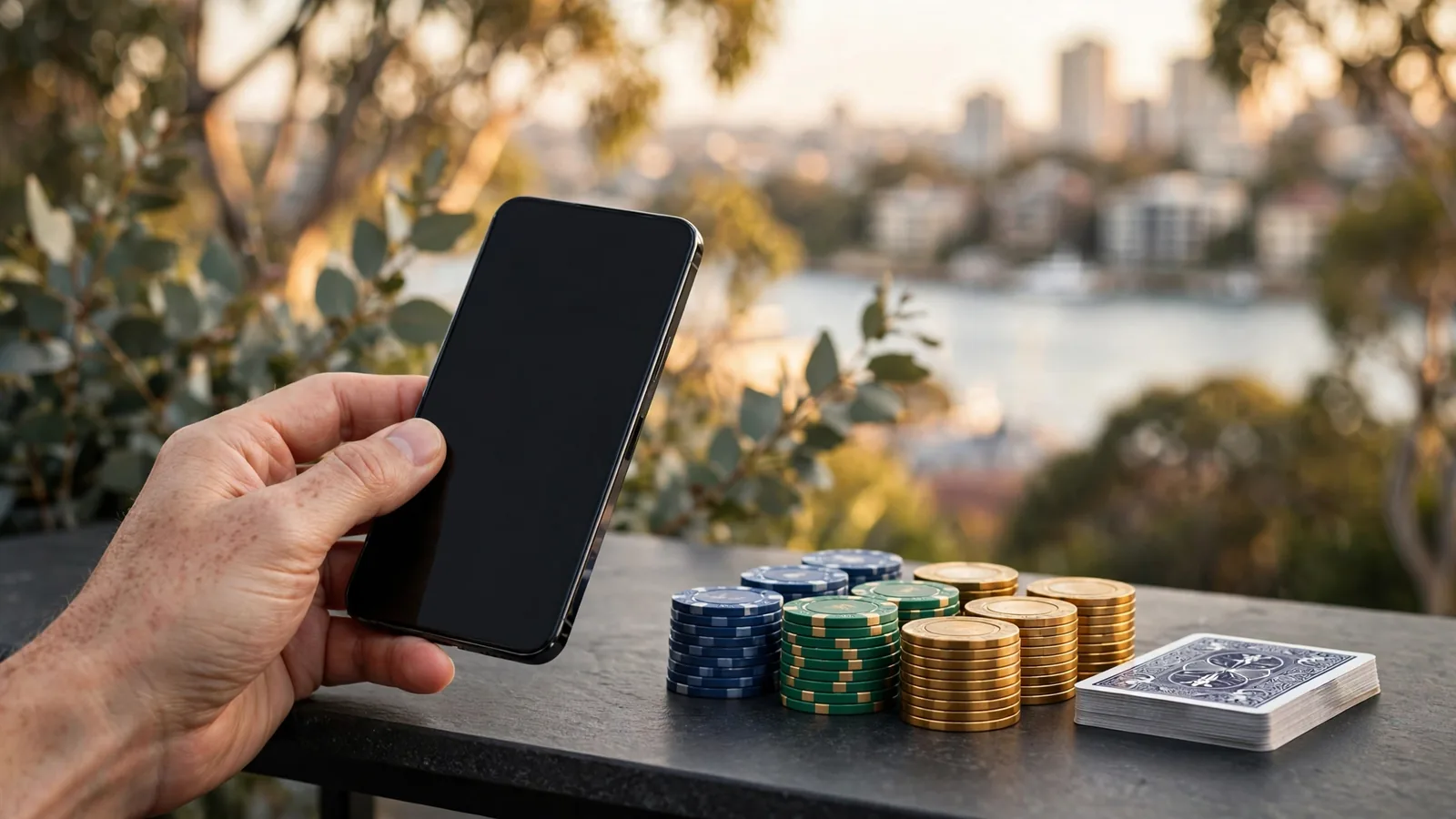
On a phone, access generally starts in the browser rather than with a dedicated casino app. You open the casino’s website in a mobile browser, sign in to your account and use the site’s mobile layout. Casinos that accept Australian players typically provide browser access or a Progressive Web App (PWA), rather than a native mobile application.
A browser is the software that opens and displays websites. When you visit a casino website, the browser requests its pages and displays them on your screen. The mobile version is designed to fit a smaller display and to work with touch input. It remains the same website, even if its layout differs from the desktop version.
Your account is associated with the casino, not with a particular device. As a result, the same account can generally be used on a phone and on a desktop computer. Signing in on a mobile browser does not, by itself, create a separate mobile account. You are accessing the site through a different screen and browser, while using the account you already have.
When choosing an Australian mobile casino, you should check the available information against what matters to you, including licensing and payment details. Use these verdicts as a concise starting point, and confirm the current terms before you play.
Golden Pokies
Golden Pokies is listed with a Curaçao license. No other operator details were supplied.
Lucky Dreams
Lucky Dreams lists a Curaçao license and a minimum deposit of A$20 via POLi.
Roby Casino
Roby Casino is listed with a Curaçao eGaming license held by Roby Games Ltd. No other operator details were supplied.
Uptown Pokies
Uptown Pokies is listed as operating since 2017 under a Curaçao license, with a minimum deposit of A$20.
LevelUp Casino
LevelUp Casino lists a Curaçao eGaming license, OGL/2023/174/0082, held by Dama N.V. Its minimum deposit is A$15.
GoldenCrown
GoldenCrown is listed with a Curaçao Gaming Control Board license, OGL/2023/176/0095, held by Hollycorn N.V. No other operator details were supplied.
SkyCrown
SkyCrown lists a Tobique Gaming Commission license and a minimum deposit of A$30. Its stated payout times are around 10–15 minutes for crypto and 1–5 days for fiat.
Bizzo Casino
Bizzo Casino is listed with a Curaçao Gaming Control Board license held by TechSolutions Group N.V. No other operator details were supplied.
JustCasino
JustCasino is listed with a Curaçao Gaming Control Board license. No other operator details were supplied.
Thor Casino
Thor Casino lists a Curaçao license held by Antillephone N.V. and identifies Versus Odds B.V. Its minimum deposit is EUR 20.
The distinction matters when you return to the site. A browser bookmark saves a route to the website; it does not install a separate casino program. You can open that bookmark later and sign in again if the site asks you to. Whether you remain signed in depends on the site and browser, so a saved shortcut should not be treated as proof that your account is still active.
A native app is installed as software on the device. A mobile website is opened through the browser, even when it presents controls that resemble an app. For Australian users, casino apps are rarely available through Google Play or Apple’s App Store. Browser access is therefore the usual route to a casino website on a phone.
This route avoids the need to find a casino app in an app store. Instead, you enter the website address in the browser or use a link to open the site. The browser then displays the website’s mobile interface. If you use the desktop version on a phone, the controls may be arranged differently or require more scrolling; the mobile layout is intended to suit the phone screen.
A PWA offers another way to open a website. It is not a separate casino account: it is a shortcut to the casino website that behaves more like a native app on a mobile device. Once installed, its icon can appear on the phone’s home screen. Tapping that icon opens the site without requiring you to locate the browser bookmark each time.
The installation begins on the casino website, not by searching an app store. Open the site in your mobile browser and look for an installation prompt. Depending on how the site presents it, the prompt may say to install the site or add it to the home screen. Tap the prompt, then confirm the installation when the browser or device asks.
The exact wording and location of the prompt can vary. Some websites display an install option within their own interface; in other cases, the browser provides an add-to-home-screen option. If no relevant prompt appears, the site may not offer a PWA installation through that browser or device. You can still access the website through the browser itself.
After confirmation, the home-screen icon acts as a direct entry point to the website. It does not turn the shortcut into a different account or a separate operator. If you have not signed in, the site may ask you to do so when it opens. If you already have an account, use the same sign-in details as you would in the browser or on a desktop.
The useful distinction is between an access method and the service being accessed. A browser tab opens the website directly; a bookmark saves a link to open later; a PWA places a website shortcut on the home screen. In each case, the destination is the casino website. The choice affects how you reach the site, not which account you use.
Installing a PWA
Open the website
Visit the casino site in your mobile browser.
Find the prompt
Look for an installation prompt or an option to add the site to the home screen.
Confirm installation
Tap the prompt and confirm the installation when requested by the browser or device.
A casino page can open on a phone yet still respond poorly once its games and controls begin loading. The screen, browser, available memory and network connection all affect how the page behaves. A specialist review identifies weak connectivity, limited device memory, an outdated browser and too many background apps as common causes of mobile casino problems. These factors can overlap, so a slow or frozen screen does not by itself show which part is responsible.
A mobile page has to receive data over the network, process it in the browser and draw the result on the screen. If the connection is unstable, parts of the page may load slowly or fail to update. You might see a loading indicator remain on screen, controls respond late, or an image appear only after a delay. Moving between areas with different signal quality can interrupt that process; a page that worked a moment ago may then need to reconnect or reload.
The phone also has to keep the browser and its open pages in memory while processing new content. When memory is limited, or other apps are using much of it, the browser may become less responsive. In some cases, switching away and back can cause a page to refresh, because the phone has stopped keeping it active. Closing unused apps may reduce that competition, though it cannot fix a weak network or a problem with the page itself.
An outdated browser can have trouble displaying newer page elements or handling their controls. The result may be a layout that looks incomplete, buttons that do not respond as expected, or repeated loading. Keeping the browser current can remove compatibility problems, but it does not guarantee that every site will work well on every device.
Screen size and touch input also shape the experience. A control placed close to another one is harder to select accurately on a small display, particularly when the page has not adapted cleanly to the phone’s dimensions. If the page zooms unexpectedly or content extends beyond the screen, check whether the browser is zoomed in and whether rotating the phone changes the layout. These steps help distinguish a display issue from a stalled connection.
Repeated tapping is rarely a useful test. If a control is waiting for the page to finish loading, another tap may not register; if the page is lagging, several taps can instead trigger the same action more than once after it catches up. Pause, check whether the screen is still changing, and reload only if the page appears to have stopped responding. Reloading may discard an unfinished session, so it is better to do it deliberately than as a reflex.
Change one condition at a time. If other pages are slow as well, the connection or phone is a more likely source than one casino page. If only one page has trouble while other browsing works, the issue may be specific to that site or its compatibility with the browser. Closing background apps can test whether the phone is under memory pressure; updating the browser can test whether an older version is involved. If performance changes when the connection changes, that points toward network quality.
This is not a guarantee that the problem can be corrected on your device. A site may itself be slow or temporarily unavailable, and the same phone can behave differently under different network conditions. Separating connection, browser and memory issues gives you a clearer diagnosis than treating every delay as a problem with the game interface.
The legal distinction in Australia is between the service provider and the person trying to use the service. Under the Interactive Gambling Act 2001, an operator must not offer online casino-style games to people located in Australia. The restriction covers services such as online slots, poker and table games. It is directed at the operator’s provision of the service; the Act does not make it illegal for an individual Australian to play at an offshore mobile casino.
That distinction does not mean offshore casino services are authorised in Australia. A site may be accessible from a phone, or may accept an account registration, without being approved or regulated under Australian gambling law. Australian residents also have no local online-casino licensing system that makes an offshore operator an Australian-regulated provider. The fact that a site operates under a licence issued elsewhere does not change that status.
The Australian Communications and Media Authority (ACMA) is responsible for enforcing rules against prohibited online gambling services. It actively blocks access to illegal gambling sites. A block can affect whether a site loads from an Australian connection; it is not a sign that the site has been reviewed for a user’s benefit, nor does it make the operator locally licensed. Attempts to get around a block using a VPN can breach an operator’s terms and may lead to winnings being voided or an account being closed.
Offshore operators may name a licensing jurisdiction such as Curaçao, Malta or Gibraltar. The Malta Gaming Authority (MGA) is a regulator in its own jurisdiction, while the other named places have their own licensing frameworks. These are not Australian authorities. An offshore licence may set rules for the operator within the issuing jurisdiction, but it does not bring the casino under Australian regulation or give an Australian player access to an Australian gambling complaints body.
This matters if a dispute arises. If an offshore casino refuses to pay winnings, there is no Australian government body to which you can complain for a local regulatory remedy. A foreign licence does not remove that practical limitation. Before depositing, confirm that the operator accepts customers located in your state or territory; an accessible website or successful registration is not proof that your location is accepted. Any casino recommendations in this context are offshore and crypto-friendly, not Australian-regulated services.
You must be at least 18 to register and gamble. Meeting that age requirement does not make the operator’s service lawful to provide in Australia, and it does not create Australian oversight of the account. Keep those two questions separate: the legal restriction on an operator is not the same as individual player liability, while the lack of player liability is not an assurance that an offshore site is safe, authorised locally or able to be held to account in Australia.
A deposit begins when you choose a method on the casino’s cashier page, enter an amount and follow the payment instructions. On a phone, that page may open a bank or payment service separately, or ask you to confirm the transaction in its app. The casino then has to match the incoming payment to your account. A delay can occur at the payment provider, during bank processing or while the casino checks the deposit.
POLi is no longer a functional local payment route as its Australian service ended in September 2023.
Payment options vary between offshore casinos and can change. Specialist reviews describe PayID, BPAY, cards and cryptocurrency among the methods that may be offered for mobile deposits. That does not mean every option will appear at every cashier, or that a method available on one site will work with your bank. Check the payment page before starting a transaction, and make sure the displayed instructions identify the correct recipient and reference details.
PayID links a payment to an identifier such as a phone number or email address rather than requiring you to enter a BSB and account number. A specialist review describes PayID deposits as near-instant and typically free, but that is a reported assessment, not a guarantee for a particular casino or transaction. Follow the cashier’s exact instructions: a wrong reference or recipient can prevent the payment from being credited as expected. Keep the confirmation from your bank until the casino balance reflects the deposit.
POLi should not be treated as a current local payment route. Its Australian service ended in September 2023, so it no longer handles transactions within Australia. If a page still displays POLi, check with the operator before sending money; an outdated label does not mean the service can complete a local payment.
BPAY, cards and cryptocurrency have different processing paths. With BPAY, the transfer passes through bill-payment processing; with a card, authorisation depends on the issuer; and cryptocurrency requires a transfer to the address and network specified by the cashier. Their processing times therefore vary. A specialist review lists these as possible mobile deposit methods, but availability and timing should be confirmed on the individual site. Do not assume that a payment method’s name alone tells you when the balance will update.
Card deposits can fail even when the card details are correct. A specialist review notes that some Australian banks block or flag gambling-related card charges. In that case, the bank’s decision may stop authorisation before the casino receives anything. Check the bank’s transaction status rather than repeatedly submitting the same payment, which could create confusion about whether a charge has been attempted.
A payment option such as PayPal should not be assumed to be available just because you are using a phone. The cashier’s current list is the practical guide; a mobile interface does not create additional payment support. Before confirming, check the currency, recipient details, any displayed fee and whether the method is enabled for your account. If the instructions or payment status are unclear, pause and contact the site’s support rather than sending a second transfer.
A no-deposit bonus may let you try an offer without first adding your own funds, but “no deposit” describes how the bonus is issued, not how easily it can be converted into withdrawable money. The key burden is the wagering requirement: the amount of eligible betting that must be completed before any bonus-related winnings can be withdrawn.
A multiplier is applied to a specified base, such as the bonus amount or the bonus plus an associated deposit. Those bases produce different turnover totals, so the multiplier alone does not tell you how much wagering is required. Check the wording that defines the base. If it is unclear, you cannot calculate the requirement reliably.
High wagering multipliers can make a bonus difficult to clear, and you may run out of funds before the requirement is met.
For illustration of the scale, specialist reviews report wagering requirements of 30x to 50x the bonus amount for welcome offers. The same kind of reviews describe requirements above 40x as steep. These are reported offer terms and assessments, not a guarantee that any particular no-deposit offer has those conditions. Read the individual offer rather than assuming the figures apply to every mobile casino bonus.
The practical effect is that a high multiplier can make a bonus difficult to clear. Each eligible wager reduces the remaining turnover, but it does not guarantee that your balance will last until the requirement is met. If the balance runs down first, you may have no funds left with which to continue. A large requirement can therefore give a bonus a higher apparent value while making its potential cash value harder to realise.
On a phone, the calculation is the same as on a desktop; the smaller screen does not reduce the wagering burden. Before accepting an offer, identify the bonus amount, the multiplier and the amount to which that multiplier applies. Then work out the total eligible turnover. If you cannot determine those inputs from the offer terms, treat the value as uncertain rather than relying on the headline amount or a bonus code.
No-deposit offers may be attached to offshore crypto-friendly casinos. Confirm that the site accepts your location before depositing or otherwise using its services. A VPN used to reach a blocked casino may lead to winnings being voided or an account being closed. Offshore casinos are not regulated by an Australian government body, and no Australian government body can help if one refuses to pay winnings.
This explanation is about wagering burden, not a recommendation to use an offer. A multiplier is only one part of the calculation: the amount that counts toward it and which wagers qualify can change how much progress you make. Review the complete conditions before deciding whether the requirement is manageable.
Any casino recommendations on this page refer to offshore, crypto-friendly operators, not Australian-regulated services. Treat a mobile site’s accessibility as a technical fact, not proof that it is authorised to serve people in Australia. Under the Interactive Gambling Act 2001, operators cannot provide online casino-style games to people located in Australia. ACMA also blocks access to illegal gambling sites. An offshore licence does not make a casino Australian-regulated.
Before creating an account or depositing, confirm directly in the operator’s current terms that it accepts customers located in your state or territory. Check whether Australia is listed as an accepted location, and whether any local restrictions apply. Do not infer acceptance from an Australian-themed page, local currency display or a working registration form. If the terms are unclear or conflict with what the site tells you, do not proceed until the operator gives a clear answer. A punter’s ability to open a mobile casino page does not establish that the operator will accept their account or honour a later withdrawal.
Look for the name of the legal entity running the casino, the jurisdiction it says issued its licence, and a way to contact its support team. Curaçao, the Malta Gaming Authority and Gibraltar are examples of licensing jurisdictions associated with casinos that accept Australian players. A jurisdiction named on a site is a starting point for checking its claims, not evidence that the service is regulated in Australia or that every dispute will be resolved in your favour.
Read the account and withdrawal conditions before handing over identity or payment details. Check that the operator explains how it handles account access, verification, complaints and disputes. Keep copies of the terms and relevant communications. If a site changes its conditions, an earlier screenshot or saved copy can help you identify what you agreed to, though it cannot guarantee a particular outcome.
Do not use a VPN to get around a block or location restriction. An operator may treat a mismatched location as a breach of its terms; using a VPN may lead to account closure or voided winnings. Confirm your location is accepted without disguising it. Playing at an offshore casino is not illegal for an individual under the Interactive Gambling Act 2001, but that does not provide the protections of an Australian-regulated casino.
Most importantly, there is no Australian government body you can complain to that can require an offshore casino to pay winnings. If the operator refuses payment, the fact that you registered from Australia does not give you a local regulator to resolve the dispute. Consider that limitation before sharing personal information or depositing, rather than relying on a mobile interface, licence badge or support promise as assurance of recourse.
A mobile session is shaped not only by the game interface but also by the controls available in the account. These settings can place boundaries on money spent, wagers made and time spent playing. A specialist review describes deposit limits, loss limits, wager limits, session-time limits and self-exclusion as responsible-gambling tools. Their practical effect depends on what each setting measures and when it takes effect.
A deposit limit sets a ceiling on funds you can add during a selected period. It does not necessarily restrict money already in the account, so it is not the same as a cap on losses. A loss limit instead tracks losses over its defined period. Check how the operator calculates that figure, including whether it considers wins or only amounts lost. A wager limit restricts the amount staked; it can slow the rate at which funds are put at risk, but it does not ensure that a session ends with money remaining.
A session-time limit addresses duration rather than spending. Depending on how it is configured, it may warn you or end access when the permitted time has elapsed. Read the setting’s description before relying on it: a reminder and a forced logout are different controls. If a session can continue after a warning, you still need to act on it.
Self-exclusion is a stronger step. It is intended to prevent access for a period selected through the operator’s process, rather than simply prompt you to pause. Before enabling it, check what the operator says the exclusion covers and whether it can be reversed. Do not treat a temporary session reminder as equivalent to exclusion.
These controls work best when chosen before you begin playing on a phone. Decide what boundary you want each one to enforce, then verify the setting is active in your account. If you need to stop, closing a browser tab is not necessarily the same as activating self-exclusion. Keep the distinction clear: limits constrain a particular measure, while exclusion is designed to block play.
The recommendations elsewhere on this page concern offshore, crypto-friendly casinos, not Australian-regulated services. Confirm that a site accepts your location before depositing. Using a VPN to reach a blocked casino may void winnings or lead to account closure. If an offshore casino refuses to pay, there is no Australian government body to complain to for recovery.
Free-play casino apps and offshore real-money casino play may look similar on a phone, but they work differently. A free-play app lets you use virtual credits to try its games. It is not the same as placing a real-money wager through an offshore casino, where account activity involves money rather than a play balance.
Social and free-play casino apps that use virtual credits are legal to use in Australia. You can find them directly in the Google Play Store and Apple App Store. Their store availability distinguishes them from casino apps that are not listed there, but it does not turn a free-play app into a real-money service. A virtual-credit balance should be understood as part of the app’s play experience, not as money held in a casino account.
That distinction matters when you search for free mobile pokies or other no-cost casino-style games. The app may let you play without making a cash deposit, but that does not mean it provides a mobile casino free-sign-up bonus. A bonus is an offer attached to a real-money account; virtual credits belong to the free-play app. Check what the app says its credits are for before treating them as something you can deposit, withdraw or exchange for cash.
Real-money casino access is a separate matter. Offshore crypto-friendly casinos may offer play through a mobile browser or, in some cases, an app obtained outside the official stores. An app installed this way is sideloaded. Sideloading means installing software from outside the store’s normal distribution route, so the store has not provided the same listing and distribution checks. That does not establish that a particular app is unsafe, but it does mean you need to consider who operates it and how the file is supplied. Sideloaded casino apps carry security risks, and their safety depends on the operator.
Do not treat searches for PayID pokies on mobile or a crypto casino for mobile as evidence that a result is a free-play app. Those phrases can lead to real-money services, which are different from games using virtual credits. Before depositing with any offshore service, confirm that it accepts your location. Using a VPN to reach a blocked casino may void winnings or lead to account closure. If an offshore casino refuses to pay, there is no Australian government body to complain to on your behalf.
For a no-cost experience, use the official app-store listing and check that it describes virtual-credit play. For real-money services, do not assume that an app-store download, a similar interface or the word “free” makes the activity equivalent.
A withdrawal request passes through several separate stages: the casino reviews it, any pending period runs, and the payment provider processes the transfer. The time shown for a payment method may cover only the last stage. Check the casino’s cashier information for its review and pending rules as well as the estimated transfer time.
Processed often in under 24 hours after the casino's pending period.
Processing time can take up to five business days.
Typically require identity checks, including a selfie and proof of address.
A specialist review describes crypto and e-wallet withdrawals as being processed in under 24 hours, but that should not be treated as a guarantee for every casino or request. E-wallets such as MiFinity, Skrill and Neteller are used for withdrawals as well as deposits. A specialist review also puts e-wallet arrival within 24 hours after the casino’s pending period; that period can therefore affect the total wait even when the payment provider is quick. For bank transfers, a specialist review gives a processing time of up to five business days. Ask whether that estimate begins when you submit the request or after the casino approves it.
The first withdrawal commonly involves identity checks. The casino may ask you for identification, a selfie and proof of address before releasing funds. Submit clear, consistent documents and make sure your account details match them. If a check is incomplete, the request may remain under review until you provide what is missing. Completing verification before requesting a payout can help avoid a document-related delay, but does not remove the casino’s review period.
Withdrawal rules can also limit your choice of method or the amount you can request. Some casinos require you to withdraw through the method used to deposit; others treat certain methods as deposit-only. A specialist review reports that some casinos set weekly or monthly withdrawal caps in the $4,000–$10,000-per-week range. Check the cashier rules for the applicable cap and whether it affects a single request or the total paid during a period.
Recommendations for Australian punters concern offshore, crypto-friendly casinos, not Australian-regulated services. Before depositing, confirm that the site accepts your location. Using a VPN to reach a blocked casino may breach its terms, void winnings or lead to account closure. If an offshore casino refuses to pay, there is no Australian government body to complain to for help recovering the winnings.
A bonus is usable only if its conditions fit your deposit, the way you intend to play and the time you have to complete them. Treat the headline offer as a starting point, not a measure of its value. A specialist review notes that wagering requirements, minimum deposits and time limits all affect whether an offer is worthwhile; the actual terms can differ between offshore crypto-friendly casinos.
Before claiming a mobile offer, check these conditions together:
The same checks apply to a no-deposit offer or a code entered during registration. A code does not override the terms: verify eligibility, the claim process and any deadline before using it. If the conditions are unclear, do not assume the most favourable interpretation.
For any offshore casino, confirm that it accepts your location before depositing. Using a VPN to reach a blocked casino may void winnings or result in account closure. There is no Australian government body to complain to if an offshore casino refuses to pay winnings. These checks explain terms; they are not a recommendation to use an offshore casino.
Yes. Free-play casino apps using virtual credits are available through Google Play and the Apple App Store.
Yes. You can use a mobile browser to access the casino website and sign in with the same account you use on desktop.
Crypto and e-wallet withdrawals are typically processed in under 24 hours; e-wallets usually arrive within 24 hours after the casino’s pending period. Your first withdrawal may take longer because it usually requires identity verification.
A native app is installed software, while a mobile browser casino is the website opened in your browser. A PWA is a website shortcut you can add to your home screen; it still takes you to the casino website.