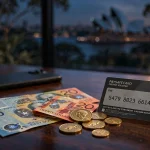
ETH describes a way to move value; it does not establish a casino’s game catalogue, bonuses, or suitability for Australian residents.

Ethereum is a payment method, not a type of casino game. When a service supports ETH, the payment process concerns moving value between a user’s cryptocurrency wallet and the service’s payment system. The games a site offers are a separate matter: using the same cryptocurrency does not make two sites’ game catalogues or payment arrangements alike.
A useful way to understand the process is to separate a payment into stages: the service presents a way to pay, the user authorises a transfer, the service records the incoming or outgoing value, and the account balance is adjusted. The exact steps depend on how a particular service has implemented cryptocurrency payments. The broad point is that Ethereum deposits and withdrawals can be instant and carry limited or no fees. “Can” matters: it describes a possible payment characteristic, not a guarantee about every transaction.
For a deposit, the process begins on the service’s payment screen, often called the cashier. If ETH is offered there, the service must provide a means of directing the payment to the appropriate destination. The user then initiates a transfer from a wallet. Once the service recognises the incoming payment, it can reflect the deposit in the account balance. This is the payment path; it says nothing about what the account can be used to access.
If you’re looking for an Australian-facing casino that accepts ETH, check the payment options directly before depositing, as the information here does not confirm Ethereum availability. The details below offer a concise reference to the listed operators and the facts provided about them.
Golden Pokies
Golden Pokies is listed with a Curaçao licence. You’ll need to confirm directly whether it currently accepts ETH.
Lucky Dreams
Lucky Dreams is listed with a Curaçao licence and a minimum deposit of A$20 via POLi. The provided details do not confirm ETH deposits, so check its payment options before signing up.
Roby Casino
Roby Casino is listed with a Curaçao eGaming licence held by Roby Games Ltd. You’ll need to check with the operator whether ETH is currently accepted.
Uptown Pokies
Uptown Pokies is listed as operating since 2017 under a Curaçao licence, with a minimum deposit of A$20. Confirm directly whether ETH is among its current payment methods.
LevelUp Casino
LevelUp Casino is listed with Curaçao eGaming licence OGL/2023/174/0082, held by Dama N.V., and a minimum deposit of A$15. The supplied details don’t specify ETH support, so verify this before depositing.
GoldenCrown
GoldenCrown is listed with Curaçao Gaming Control Board licence OGL/2023/176/0095, held by Hollycorn N.V. Check with the casino to confirm whether it accepts ETH.
SkyCrown
SkyCrown is listed with a Tobique Gaming Commission licence and a minimum deposit of A$30. Its stated payout speeds are around 10–15 minutes for crypto and 1–5 days for fiat; the details do not specify whether ETH is supported.
Bizzo Casino
Bizzo Casino is listed with a Curaçao Gaming Control Board licence, held by TechSolutions Group N.V. You’ll need to verify directly whether ETH deposits are available.
JustCasino
JustCasino is listed with a Curaçao Gaming Control Board licence. The provided information doesn’t say whether it accepts ETH, so check its current payment options.
Thor Casino
Thor Casino is listed with a Curaçao licence held by Antillephone N.V. (Versus Odds B.V.) and a minimum deposit of EUR 20. Confirm directly whether ETH is accepted.
A withdrawal runs in the opposite direction. The user requests a payout through the service, and the service sends cryptocurrency to the destination specified for the transfer. The account balance is then adjusted to reflect the payout. Deposits and withdrawals are separate operations, so a statement about one does not automatically establish the speed or cost of the other.
The word “instant” should be read as a broad description, not as a promise that every step is immediate. A transfer involves both the movement of cryptocurrency and the service’s handling of the account balance. Those are related, but they are not identical. A payment may have a rapid transfer characteristic while the service’s own account processing follows its own procedure. Likewise, “limited or no fees” does not mean that every service charges nothing, or that all costs associated with using cryptocurrency are necessarily absent. The actual terms attached to a payment depend on the service and transaction.
The balance shown after a deposit is also an account record, not the game itself. Payment support tells you about a route for moving value; it does not explain how a game operates, which games are offered, or whether a particular game can be accessed. The same distinction applies to a live-dealer label, mobile access, or a reference to pokies: none of those describes the movement of ETH. They concern other parts of a service.
This separation helps prevent a common misunderstanding. A site’s mention of Ethereum does not, by itself, establish that every part of its payment process uses ETH, that withdrawals follow the same timing as deposits, or that a particular balance will be available for every purpose. It identifies a payment option only where that option is actually supported. Payment arrangements are not interchangeable merely because they involve the same cryptocurrency.
For Australian readers, the phrase “Ethereum casino” can therefore combine two different ideas: a payment method and an online gambling service. The payment mechanism can be described in general terms without treating that phrase as proof that a service is available to Australian residents. Nor does a cryptocurrency transfer determine the legal status of the activity for which an account might be used.
The practical model is simple: ETH is the value being transferred; a wallet initiates or receives the transfer; and the service’s payment system records the result. Speed and fees describe possible characteristics of that movement, not a guarantee about a particular cashier, account balance, or game. Keeping those parts separate makes it easier to understand what a payment label does—and does not—tell you.
Calling an online casino “best” is a comparative claim. It implies that identifiable services have been assessed against consistent criteria and that the result applies to the reader’s circumstances. A payment method alone cannot support that conclusion. The fact that cryptocurrency, including Ethereum, can be used for online transactions does not identify a particular casino, establish that it accepts ETH, or show that it is suitable for someone in Australia.
Attention: A payment method alone cannot identify a particular casino, establish that it accepts Ethereum, or prove it is suitable for users in Australia.
That distinction matters when assessing descriptions such as an Ethereum casino, an online casino that accepts ETH, or a site presented as the best option. These phrases combine separate propositions: that a service exists, that it supports a particular payment method, and that it can be compared favourably with alternatives. Each proposition needs its own substantiation. Without evidence tying a named operator to current Ethereum payment support, there is no sound basis for treating that operator as an Ethereum casino, let alone ranking it.
The same caution applies to labels such as “online pokies” or “live casino.” Those labels concern what a service offers, not merely how a payment is made. A reference to Ethereum does not verify a game catalogue, a live-dealer product, or access for people located in Australia. Combining a game category with a payment method in a description does not prove that the service provides both.
A meaningful comparison starts with services that can be identified and assessed. It would then need to establish which payment methods each service supports, whether that support applies to the reader’s location, and what conditions govern the relevant transactions. If those details are not established, a ranking can create an impression of precision without giving you a reliable basis for distinguishing one option from another.
“Best” also depends on the criteria being used. One person might mean that a payment method is available; another might mean that a service is accessible from Australia or that its terms are clear. Those are different tests. A ranking that does not state its criteria, or cannot show that the services were assessed consistently, does not explain what its order means. It may simply place names in a sequence.
For a claim about an Ethereum casino in Australia, location is not a minor detail. Payment availability in one market does not establish availability in another. Nor does a general statement about cryptocurrency transactions confirm that an individual operator accepts ETH from an Australian customer. Without a substantiated link between the service, the payment method and the relevant location, a confident recommendation would go beyond what can responsibly be said.
This is why a list of “best” Ethereum casino sites cannot be treated as a neutral answer merely because it is formatted as a ranking. A numbered order can look definitive, but presentation does not supply the missing basis for comparison. The same applies to claims about the best online option or the best site for pokies: a category label and a favourable adjective do not verify the underlying service or its availability.
Ethereum’s general use as a payment method should not be confused with an endorsement of any operator. The transaction mechanism and the operator’s overall quality are separate matters. Even if a payment method can support quick transfers with limited or no fees in some circumstances, that does not establish an operator’s reliability, its terms, its products, or its suitability for an Australian resident.
A responsible description therefore has to keep its claims narrow. It can explain what is known about cryptocurrency transactions in general, but it should not turn that general point into a promise about a particular casino. It should not imply that an operator accepts Ethereum unless that specific support is established, or that a service is “best” without a defensible comparison. A reader should be able to tell the difference between a general statement about a payment method and a verified statement about a named service.
The wording “best Ethereum casino” can also conceal several different questions. It may refer to a site that accepts ETH, an online casino that offers certain games, or a service that is available to people in a particular place. Those questions cannot be answered by one broad claim. Evidence for one does not automatically answer the others, and a payment label cannot stand in for proof about the rest.
For Australian readers, a recommendation would be especially misleading if it implied that offshore casino services are approved or endorsed for use. The fact that a payment route exists does not change the legal status of an operator’s services. Describing an unverified service as a suitable choice would blur that distinction rather than clarify it.
The sound conclusion is limited but useful: Ethereum’s role as a payment method does not establish which casino services accept it, which are accessible to Australians, or which deserve to be called the best. Until those separate points are substantiated, a ranking or recommendation would claim more than the payment information can show.
A ranking needs more than a label such as “Ethereum casino.” It needs comparable evidence about the services being ranked and a clear basis for deciding what counts as better. Without that, ordering sites would suggest a level of testing and certainty that the comparison cannot support.
Ethereum payment support, by itself, says little about the quality of a casino. It does not establish whether an operator handles withdrawals reliably, explains its conditions clearly, or provides a consistent service. Nor does the general possibility of instant cryptocurrency deposits and withdrawals with limited or no fees establish how a particular operator processes transactions. Those payment characteristics cannot serve as a score for the overall experience.
The same distinction applies to bonuses. Calling an offer the best requires evidence that it exists and details sufficient to compare it with alternatives. A meaningful assessment would need to account for the offer’s eligibility rules and conditions, including any wagering requirement, expiry, withdrawal restriction or game restriction. A headline bonus amount alone would not show what a player must do to use the offer or whether its terms are favourable.
A “best Ethereum casino bonus” label can therefore create a false impression even when the underlying words sound precise. It implies that offers have been checked against one another and that the ranking reflects their actual terms. Without that comparison, the label is a verdict without a demonstrated method. The same problem arises with a list of leading Ethereum casino sites: naming operators in a ranked order would imply that their products and relevant conditions had been assessed on a common basis.
A useful ranking also needs a defined purpose. One person might prioritise payment costs; another might care more about withdrawal handling or the clarity of conditions. Those criteria cannot be collapsed into a universal winner unless the comparison explains how each factor is weighed and supports the underlying claims. A site’s acceptance of Ethereum cannot fill those gaps, and a bonus cannot be judged separately from the rules attached to it.
The point is not that every operator or offer is equivalent. It is that a ranking would make a distinction between them without a sound basis for doing so. Treating an unsupported ordering as useful guidance could lead you to mistake a promotional description for an independent assessment.
If you encounter a ranking elsewhere, read the method before relying on its order. Check whether it identifies the criteria, explains how the criteria affect the result, and gives enough detail to assess the terms being compared. A list that supplies names but not a reproducible basis for the ranking cannot show why one entry belongs above another. Likewise, a bonus headline does not establish the value of an offer without its conditions.
Ethereum transactions may have general characteristics, but those do not establish which casino is better or which bonus is preferable. A defensible comparison depends on operator-specific evidence and terms that can be checked side by side. Without that foundation, leaving the ranking empty is more accurate than presenting a winner.
An Ethereum payment method and a casino promotion are separate things. A site’s ability to process cryptocurrency deposits or withdrawals does not, by itself, establish that it offers a deposit bonus, a no-deposit offer, or any particular slot product. Each claim concerns a different part of the service and needs its own evidence.
Cryptocurrency transactions can be instant and carry limited or no fees. That general payment characteristic says nothing about the terms a casino might attach to an offer. It does not tell you whether a bonus exists, who can claim it, whether a deposit is required, or what conditions apply before funds can be withdrawn. Those details depend on the terms of a specific promotion, not on the currency used to pay.
The same distinction applies to welcome offers and other deposit bonuses. A payment option is not evidence that a matching promotion is available. Nor does the wording of an offer establish how it works: the full terms would need to specify eligibility, qualifying payments, restrictions and any withdrawal conditions. Without those details, a bonus cannot be described reliably as available or assessed as suitable.
“No deposit” is a particular claim, not a general property of Ethereum casinos. The phrase would need to be supported by an offer’s actual conditions, including whether a payment or other requirement is involved. Cryptocurrency support alone cannot establish that a free offer exists or explain what a customer would have to do to use it.
Transaction information concerns how money moves, bonus information concerns offer rules, and game information concerns available content. Treating one as proof of another can make an unsupported offer sound confirmed.
Slot-related claims require separate support too. A payment method does not identify a casino’s catalogue, confirm that it contains online slots, or verify any particular title. Calling an offer a slots bonus would also require evidence linking the promotion to those games and showing the applicable terms. An Ethereum deposit does not provide that information.
For you, the practical distinction is between a transaction claim and a product or promotion claim. Transaction information concerns how money moves; bonus information concerns an offer’s rules; game information concerns what a service makes available. Treating one as proof of another can make an unsupported offer sound confirmed.
Before relying on a promotion, read its terms as a separate document from the payment instructions. Look for the conditions that define who can participate and what happens to the balance under the offer. If those conditions are not clear, you cannot determine the offer’s actual value or restrictions from the fact that Ethereum is accepted.
The same standard applies whether an offer is described as a welcome bonus, a deposit bonus, a no-deposit bonus, or a promotion linked to slots. Those labels do not establish the underlying terms, and cryptocurrency payment capability does not fill in the gaps. Keep payment, promotion and game claims distinct: evidence for one does not verify the others.
An Ethereum payment method and a casino’s game catalogue are separate parts of a service. The payment method describes how value may move into or out of an account. The catalogue describes what the operator makes available to users. Knowing one does not establish the other.
Think of them as separate system settings. A payment processor can be configured to handle Ethereum without determining which content an operator provides. Conversely, a catalogue may contain particular types of games without accepting Ethereum. The currency used for a transaction does not, by itself, identify the software, providers or rules behind the service.
This distinction matters when you see a claim that a site accepts ETH. At most, that wording concerns a payment option; it does not confirm that any particular game is available, or that the service is accessible to you. The same applies to broad phrases such as “Ethereum games” or “casino games with Ethereum”: they can blur the payment method and the content into one label, even though they answer different questions.
To establish what a catalogue contains, you would need information about the operator’s actual offering. A cryptocurrency symbol, wallet address or payment notice cannot supply that information. Nor does an Ethereum payment claim substantiate a claim about a specific game, game type or bonus. Those details need separate support and should not be inferred from the payment method.
The reverse is also true. A page that mentions a game category does not demonstrate that Ethereum is accepted for deposits or withdrawals. Payment support can depend on the operator’s arrangements, while catalogue content is a separate matter. Treating either as proof of the other risks mistaking a label for evidence.
An account interface can also present payment information and content information side by side. Their proximity does not make them causally linked. A payment option does not add games to a catalogue, and a catalogue entry does not change how a transaction is processed. If a service changes one of these settings, that change does not automatically establish a change to the other.
For Australian readers, this separation is particularly important: a payment claim is not evidence that a service is lawful to provide locally or available for local use. Ethereum does not alter the nature of the underlying service. It describes a way of transferring value, not what the operator offers or whether Australians may be offered it.
So, when assessing a statement about Ethereum and casino content, keep the claims distinct. Ask whether the statement concerns payment support or the catalogue; do not use one as proof of the other. A mention of ETH alone tells you nothing reliable about which games, if any, are offered.
For someone in Australia considering an offshore casino that uses Ethereum, the key legal distinction is who the law regulates. The Interactive Gambling Act 2001 targets the provision of prohibited online casino services to people in Australia. It does not explicitly make an individual player’s use of an offshore site a criminal offence.
That distinction concerns the operator’s conduct, not the payment method. Using Ethereum does not change whether a service is an online casino or alter the law governing its provision. A transaction made with cryptocurrency is still a means of payment; it does not create an exception to the rules for online gambling services.
The law’s focus on operators also should not be read as approval of offshore gambling. The fact that the Act does not expressly criminalise a player for using an offshore site does not make the operator’s service lawful to provide in Australia. Nor does it mean a player has the same position as someone using a service that is permitted under Australian law. The legal questions for the provider and the user are different.
This matters when reading claims about being able to play casino games with Ethereum. A site’s willingness to accept a payment, or a player’s ability to access its pages, does not establish that the service may lawfully be offered to people physically located in Australia. Payment technology and the legal status of the gambling service are separate matters.
The relevant boundary is therefore not whether the balance is held in Australian dollars or cryptocurrency. It is whether an operator is providing online casino gambling to a person in Australia. The Act prohibits operators from providing that kind of service to Australian residents, while not explicitly criminalising those residents for using offshore sites. Describing one side of that distinction without the other can give a misleading impression: a lack of an express player offence is not a permission for operators to serve the Australian market.
If you are assessing a claim about an Ethereum casino, keep those two questions separate: what the payment method does, and whether the gambling service may be provided to someone in Australia. Ethereum does not determine the answer to the second question.
Legal Boundary
The Interactive Gambling Act 2001 prohibits operators from providing real-money online casino services to people physically located in Australia.
A payment method does not determine whether an online gambling service is lawful in Australia or whether Australian consumer protections apply to it. Ethereum is a way to transfer value; it does not give an offshore casino Australian authorisation or make a transaction subject to Australian consumer law.
The Interactive Gambling Act 2001 prohibits operators from providing real-money online casino services to people physically in Australia. The Australian Communications and Media Authority (ACMA) administers enforcement of that law. Its role is to enforce the national restrictions, not to certify that a particular offshore service is safe or to guarantee that a customer can recover funds after a dispute.
This distinction matters if you are assessing a site described as an Ethereum casino. A payment page that mentions ETH says something about the payment method the operator claims to support. It does not establish that the operator may lawfully offer casino services to Australian residents, nor does it provide the protections associated with Australian consumer law. The same applies whether you access a site on a phone or another device.
Australian consumer law does not protect people using offshore casinos. If a disagreement concerns an account, a payment or a withdrawal, you should not assume that Australian consumer protections will provide a remedy simply because you are in Australia or because the transaction involved Ethereum. The payment itself does not change the operator’s location or the legal status of the service.
There is also a practical distinction between a regulator enforcing a law and a regulator acting as a customer-support channel. ACMA’s enforcement role concerns the Interactive Gambling Act; it should not be treated as a promise that it will resolve an individual customer’s payment dispute. A claim that an offshore service accepts ETH therefore cannot, by itself, answer questions about legality, consumer remedies or the outcome of a complaint.
For Australian readers, the relevant checks are not limited to whether a cashier displays an Ethereum option. The legal setting and the limits of consumer protection remain relevant regardless of the cryptocurrency named. A site’s own payment description cannot replace those considerations, and Ethereum does not create a separate consumer-protection framework for offshore gambling.
Cryptocurrency payments can have different timing and fee characteristics from bank transfers. Bitcoin and Ethereum deposits and withdrawals can be instant, with limited or no fees. That describes a possible feature of cryptocurrency transactions; it does not establish the timing or cost of a particular payment through a casino.
For you, the distinction is between the currency’s general payment characteristics and the terms applied to an individual transaction. An Ethereum payment may be processed quickly, but the word “instant” is not a guarantee that funds will appear immediately in every circumstance. The fee may also be low or absent, rather than necessarily zero. Timing and charges can vary by transaction and by the service handling it.
This matters for both deposits and withdrawals. A fast deposit does not, by itself, mean a withdrawal will be just as fast. Nor does a general statement about cryptocurrency withdrawals establish that a specific Ethereum casino will send funds immediately or without a charge. The same caution applies when you see a claim about fast or instant withdrawals: it needs to describe the relevant payment conditions, not merely repeat a broad description of cryptocurrency.
The terms “no-deposit” and “bonus” refer to offers, not to the timing or fee structure of an Ethereum transaction. The general payment characteristics above do not establish that a no-deposit offer or bonus code is available, or what conditions would apply. Keep those questions separate from whether a cryptocurrency payment can move quickly and at limited cost.
If you are assessing an Ethereum payment, treat speed and fees as separate points. A transaction may be fast but still carry a charge; a low-fee transaction may not be immediate. The broad characteristics of cryptocurrencies do not settle either point for an individual payment. Avoid treating “instant” or “no fee” as a universal promise.
A casino’s acceptance of Ethereum would describe a payment option, not confirm that it offers live-dealer tables. Those are separate features: one concerns how funds move, while the other concerns the games a platform makes available. A reference to an “Ethereum live-dealer casino” therefore does not, by itself, establish that a particular service supports both.
The same caution applies to broad descriptions such as crypto casino or Ethereum casino: they do not establish which games are offered, whether Ethereum can be used for them, or whether the service may lawfully provide them to someone in Australia.
There is also a legal boundary that payment details cannot change. Under the Interactive Gambling Act 2001, operators may not provide real-money online casino games to people physically located in Australia. The Australian Communications and Media Authority is responsible for enforcing that law. An offshore operator’s payment methods or game catalogue do not make the provision of prohibited casino services to Australian residents lawful.
For a reader assessing a claim about live dealing and Ethereum, keep three questions distinct: does the service support Ethereum payments; does it actually offer live-dealer games; and may it provide those games to a person in Australia? A statement answering one does not answer the others. In particular, a deposit option cannot establish a live-game catalogue or resolve the Australian legal restriction.
This distinction matters because a phrase combining Ethereum and live dealers can sound like a confirmed product description when it may only be a broad label. The legal position remains the same regardless of whether a site describes itself as an Ethereum casino, a crypto casino, or a live-dealer platform.
An Ethereum payment method and a casino’s game catalogue are separate things. Knowing that a site can process ETH would not, by itself, tell you whether it offers any particular type of game. Nor does the word “Ethereum” in a site description establish which games, if any, are available.
The same applies to claims that a particular service is trusted or licensed for Australian players: those labels need evidence about the operator and its status, not just a reference to cryptocurrency.
The legal setting also matters. Under Australia’s Interactive Gambling Act 2001, operators cannot provide real-money online casino games, including slots, to people in Australia. A payment method does not change that rule or make a casino offer lawful. A label such as “licensed Ethereum casino” should therefore not be read as evidence that an operator may legally provide online casino games to Australian residents.
If you encounter a claim about Ethereum and slot games, separate its parts: whether ETH is mentioned as a payment option, whether the operator actually offers the stated game, and whether the service may lawfully be offered in Australia. One claim does not prove the others.
Limits are set by each casino and can vary; Amex limits are usually higher than those for Visa or Mastercard. Check the casino’s cashier or payment terms for its current deposit and withdrawal limits.
Jackpot City Casino, Spin Palace, Ruby Fortune, Ignition Casino, Joe Fortune, and PlayAmo are among the operators that support Amex deposits for Australian players. Acceptance can vary, and some casinos do not accept Amex.
Amex deposits are typically free, but a casino may charge a surcharge, and withdrawals may incur a fee. Currency conversion can also incur a fee.
Yes. Each casino sets its own Amex deposit and withdrawal limits, and they can vary; Amex limits are usually higher than Visa or Mastercard limits. Check the casino’s cashier or payment terms for the applicable limits.
Yes, you can use an Amex gift card to deposit at a casino that accepts American Express, but it can be used for deposits only.
Amex deposits are typically fee-free, but a casino may add a surcharge and withdrawals may incur fees. Currency conversion can also incur a fee.